显示标签为“VOA Special English_American Mosaic”的博文。显示所有博文

12.10.2007

VOASE1206_American Mosaic

06 December 2007
A Museum in Pittsburgh Gives Its Dinosaurs a Timely Makeover

Download
Download

HOST:

Welcome to AMERICAN MOSAIC in VOA Special English.

(MUSIC)

I'm Doug Johnson. On our show this week:

We listen to some music from Judy Kuhn …

Answer a question about the Space Race …

And tell about a new display of dinosaur bones.

Dinosaurs In Their Time

HOST:

A family at the Cretaceous Seaway part of the exhibit

Dinosaurs are not what they used to be, at least not at the Carnegie Museum of Natural History in Pittsburgh, Pennsylvania. Katharine Cole tells us about big changes in the museum's Dinosaur Hall.

KATHARINE COLE:

The Carnegie Museum has one of the largest collections of dinosaur bones in the world. The only problem is that the way they were presented all these years was wrong.

Visitors might have come away with the idea that all dinosaurs were huge, slow moving creatures. But newer discoveries show that dinosaurs were generally smaller and faster than scientists once thought.

So directors of the Carnegie Museum decided to rebuild the ten dinosaurs in their collection. And they added new ones.

Andrew Carnegie, the wealthy businessman, built the Dinosaur Hall a century ago. He paid for a scientific trip that discovered a new kind of dinosaur. Those bones are still in the collection. But it was time to give the hall a makeover. Now, after more than two years and thirty-six million dollars, most of the work is finished.

The museum opened its new exhibit to the public on November twenty-first. The collection is now called "Dinosaurs in Their Time."

Museum officials say the aim is to show the great diversity of life that existed during the Mesozoic period. The dinosaurs are placed among examples of the hundreds of plants and animals that shared their environments.

Officials say they wanted to show the way groups of dinosaurs really lived. The rooms in the exhibit hold plants and animals that existed more than one hundred fifty million years ago. And they show how some creatures evolved into animals that exist today.

The new exhibit at the Carnegie Museum of Natural History in Pittsburgh is three times the size of the old one. It will hold nineteen dinosaurs once the second part opens in the spring.

The Space Race

HOST:

Our VOA listener question this week comes from Cambodia. Rey Sopheak asks about the history of the space race between the United States and the former Soviet Union.

It began fifty years ago. In October of nineteen fifty-seven, the Soviets launched the first manmade satellite into orbit around Earth. It was called Sputnik One. Weeks later Sputnik Two was launched.

Their success was a victory for the Communists. It added to the tensions of what was known as the Cold War, which many people worried could lead to nuclear war. And it pushed Americans to teach more science and math in school -- and to work harder to reach outer space.

Three months later, the United States launched its own satellite. Then, in nineteen sixty-one, the Soviet Union sent the first person into space, Yuri Gagarin. American Alan Shepard followed less than a month later.

Neil Armstrong took this picture of Buzz Aldrin during the Apollo 11 mission to the moon
The race continued. The finish line was the moon. And it was reached when the crew of Apollo Eleven landed in nineteen sixty-nine. Americans returned to the moon five more times. No one has been back since nineteen seventy-two. NASA, the American space agency, hopes to send astronauts to the moon again by two thousand nineteen. That will be the fiftieth anniversary of the first landing.

Today, there is cooperation between the Russian and American space programs. Astronauts and cosmonauts share duties on the International Space Station. And other countries are expanding their space programs.

In two thousand three, China became the third country ever to send a person into space using its own rocket. Then, in two thousand five, it sent a crew of two on a five-day flight. Another manned trip is planned next year. And China launched a moon orbiter in October.

Other active countries include Japan, India and South Korea. Some experts say that space exploration today should not be compared to the Cold War space race fifty years ago. Just this week, a Chinese official said his country's moon orbiter has no military purposes and that China supports the peaceful use of space.

Judy Kuhn Sings Laura Nyro

HOST:

Laura Nyro was one of the most influential singers and songwriters of the nineteen sixties and seventies. Judy Kuhn is a Broadway singer who has performed on concert stages around the world. Their talents combine on a new album. Shirley Griffith plays some of the music.

SHIRLEY GRIFFITH:

Judy Kuhn has been nominated for several awards for singing in musicals on Broadway in New York. She has also performed in musicals in other cities, in concert, on television and in movies. Her new album is called "Serious Playground: The Songs of Laura Nyro."

Judy Kuhn says Laura Nyro's songs live in a world where loneliness and loss exist side by side with joy in the pleasures of life. Here she sings "Sweet Blindness."

(MUSIC)

Laura Nyro was born in New York in nineteen forty-seven. She began writing songs as a teenager. Her songs combined the music of gospel, pop, soul, folk, rock and jazz.

When she was nineteen, she released the first of four albums of personal and emotional songs. Judy Kuhn says this opened the door for female songwriters who at that time were not recording their own songs.

Several of Laura Nyro's songs became huge hits when they were recorded by other performers. These include Barbra Streisand, the Fifth Dimension, Blood, Sweat and Tears and Three Dog Night. Here Judy Kuhn sings "Stoney End."

(MUSIC)

Laura Nyro died of ovarian cancer in nineteen ninety-seven at the age of forty-nine. Her music influenced many female singer-songwriters working today. Judy Kuhn recorded "Serious Playground" to honor the composer of these beautiful, sad and joyful songs. We leave you with "Save the Country."

(MUSIC)

HOST:

I'm Doug Johnson. I hope you enjoyed our program today.

Our writers were Shelley Gollust and Nancy Steinbach. Caty Weaver was our producer. Transcripts and MP3 files of our programs are at voaspecialenglish.com.

Send your questions about American life to mosaic@voanews.com. And please include your full name and where you are from. Or write to American Mosaic, VOA Special English, Washington, D.C., two-zero-two-three-seven, U.S.A.

Join us again next week for AMERICAN MOSAIC, VOA’s radio magazine in Special English.

11.30.2007

VOASE1129_American Mosaic

29 November 2007
Smith, Say Hi to Garcia: Top 10 US Names Now Have Two Hispanic Ones

Download
Download

HOST:

Welcome to AMERICAN MOSAIC, in VOA Special English.

(MUSIC)

I'm Doug Johnson. On our show this week:

We listen to some music from Deborah Harry …

Answer a question about the iPod …

And tell about a recent report listing common names in America.

Census Study of Names

HOST:

The English poet and playwright William Shakespeare asked “What’s in a name?” The United States government has an answer. Faith Lapidus explains.

FAITH LAPIDUS:

The United States Census Bureau has released a report about family names. The information comes from the study of the American population in two thousand.

The report tells the most common last names of Americans and some information linked to them. It says people recognize others by their names, and that people can tell a lot about a person just from knowing his or her name.

Almost two hundred seventy million people provided information to the Census Bureau in two thousand. The researchers found six million different last names among them. One million or more people have one of seven names. The most common is Smith. More than two million people answer to that name.

The next most common names are Johnson, Williams, Brown, Jones, Miller and Davis. More than one million people are called each of those names. Two hundred sixty-eight other family names are also fairly common. Each of those names is shared by more than one hundred thousand people.

Students in New Mexico perform a traditional Hispanic dance
The study also found that for the first time, two Hispanic names are among the top ten most common names in the country. They are Garcia and Rodriguez. Each name is shared by more than eight hundred thousand people. The report says more than ninety percent of all people with those names are Hispanic.

One newspaper report says it is probably the first time that any non-English sounding name has been listed among the most common. The presence of those names on the list shows that an increasing number of Hispanic people are living in the United States. The number grew by fifty-eight percent in the nineteen nineties to almost thirteen percent of the population.

Other Hispanic names appearing in the top twenty-five most common names are Martinez, Hernandez, Lopez and Gonzalez.

iPods

HOST:

Our listener question this week comes from Burundi. Josephine Uwangabe wants to know about the small iPod device made by the Apple computer company. The iPod is the most popular device made for storing and playing digital music. Because of its size, iPod users can enjoy listening to music while on the go.

In two thousand, Apple realized that digital music players were not selling because they were not well designed. Apple decided to change this. The company worked to develop a device that would have a fast computer connection so songs could go from a computer to the player quickly. The device also had to work well with Apple’s music program called iTunes, which permits users to easily organize thousands of songs. It had to be very easy to use. And it had to be good looking.

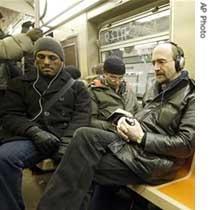
Have iPod, must travel ... on a New York subway
An advertising writer on Apple's team came up with the name iPod. He was influenced by the movie “2001: A Space Odyssey.” He saw the music device as a small “pod” that attached to a main spaceship, or, in this case, a computer. Apple released the first iPod in October, two thousand one.

Since then, Apple has developed several versions of the device. Some iPods are small enough to fit in your hand, while others can play videos, store photographs or connect to the Internet. They come in different colors, prices, and memory storage sizes. In October, Apple announced that it had sold one hundred and twenty million iPods.

Experts say these revolutionary devices are having a big effect on the music industry. Apple has sold over one billion digital songs from its iTunes program. This represents important income for many record companies that have been experiencing reduced album sales. Museums and schools are using iPods to play educational programs for visitors and students.

iPods have changed the way people listen to music. It would be hard to walk down a busy street or college campus in America without seeing several people with iPods and earphone devices. Music lovers can now hold thousands of songs in the palm of their hand.

Deborah Harry

(MUSIC)

HOST:


That was Deborah Harry singing with her band Blondie. The post-punk/new wave group had many hits in the late nineteen seventies and eighties. Shirley Griffith has more about Deborah Harry's new album, "Necessary Evil."

SHIRLEY GRIFFITH:

Deborah Harry's has a new solo album after fourteen years of silence. Here is “Two Times Blue” from “Necessary Evil.” The song made it into the top ten of Billboard Magazine’s Hot Dance Club Plays in the United States.

(MUSIC)

“Necessary Evil” came out last month. Harry started a series of live shows to support the album this month. She began the tour at the Fillmore Theater, in her hometown of New York City. Critics have praised Deborah Harry for staying current in her musical style. “Necessary Evil” is not a re-visiting of Blondie. Harry says she still loves the music of Blondie and many former punk bands. But she says musicians have to keep moving forward. She says being stuck in the past equals death for an artist. Here Deborah Harry sings the romantic song “If I Had You.”

(MUSIC)

Deborah Harry wrote the songs on “Necessary Evil.” She told one reporter that the album is about love and relationships like most pop songs. Harry herself has been married three times. She said she is in love with love --- sometimes. We leave you with Deborah Harry singing “Naked Eye.”

(MUSIC)

HOST:

I'm Doug Johnson. I hope you enjoyed our program today. It was written by Dana Demange, Nancy Steinbach and Caty Weaver, who also was our producer. To read the text of this program and download audio, go to our Web site, voaspecialenglish.com.

Join us again next week for AMERICAN MOSAIC, VOA’s radio magazine in Special English.

11.24.2007

VOASE1122_American Mosaic

22 November 2007
How Green Day Has Redefined Punk Rock for a Wider Audience

Download
Download

HOST:

Welcome to AMERICAN MOSAIC in VOA Special English.

(THEME)

I'm Doug Johnson. On our show this week:

We listen to some music from the group Green Day …

Report about an art show by some very special young artists …

And explain why the day after Thanksgiving has a special name.

VSA arts

HOST:

VSA arts is an organization that works to give people with disabilities a chance to learn about and enjoy the arts. For six years, the group has partnered with the automobile company Volkswagen of America to create a competition to support artists with disabilities. The artists are between the ages of sixteen and twenty-five. This year, over two hundred artists entered the contest. A group of art experts chose fifteen winners. The artists received a total of sixty thousand dollars in prize money. Steve Ember has more.

STEVE EMBER:

Every year, the VSA arts competition chooses a subject for its art competition. This year, the theme and name of the exhibition is “Driven.” The artists were asked to make works that show what forces and ideas move them to create.

Twenty-one year old Jacolby Satterwhite from Baltimore, Maryland,

Jacolby Satterwhite's ''Remission and Resilience'' received first prize in the VSA arts competition
won the twenty thousand dollar first prize for his painting “Remission and Resilience.” This large and colorful painting shows six people doing different activities. Behind them is an expressive blue and orange sky.

Jacolby started making art at the age of three. But by age eleven, he developed bone cancer and had to have parts of his right arm removed. This disability did not stop him from creating his art. He says continuing to make art with these limits is a way of winning over a dark period in his life.

Laurel Ebenal from the state of Washington won second prize for her “Faun” photograph of a person wearing a theatrical face covering. Laurel is influenced by an imaginary world of dreams and stories. Although she has lost half of her hearing, she says her art permits her to express herself in ways that words cannot.

E. Brooke Lanier from Chicago, Illinois won third prize for her painting called “Staring.” Her art expresses what it is like for an artist to go blind. The painting has a white background with bold black letters. It looks like the picture an eye doctor uses to test a person’s eyesight. The letters start big, then get smaller towards the bottom. The letters say: “I cannot see you but I know you are staring at me.”

Green Day

HOST:

Our listener question this week comes from Russia. Viacheslav wants to know about the rock group Green Day. This band is considered to have brought punk rock style music to a wider audience of listeners.

From left, Billie Joe Armstrong, Tre Cool and Mike Dirnt
Billie Joe Armstrong and Mike Dirnt from Berkeley, California, formed the band in nineteen eighty-seven when they were fifteen years old. The two friends gave their first performance at the restaurant where Billie Joe’s mother worked.

Billie Joe and Mike later asked Tré Cool to replace Green Day’s first drummer who left the group to attend college. The band’s first two full-length albums were called “1,039/Smoothed Out Slappy Hours” and “Kerplunk.” Their first album with a large record company came out in nineteen ninety-four. “Dookie" sold over ten million copies around the world. It also earned the group a Grammy Award for Best Alternative Group. Here is the hit song “Basket Case” from that album.

(MUSIC)

In nineteen ninety-five, Green Day released the album “Insomniac” which had a darker and more intense sound. Two years later, the group released “Nimrod.” The album “Warning” earned Green Day eight California Music awards, though it was not one of their best selling albums. Here is the song “Minority” from that album.

(MUSIC)

Green Day later began making a new album, but the recordings of the songs were stolen from the band’s music studio. Green Day decided not to recreate the same album. They decided to do something different. In two thousand four they released “American Idiot” which became an international best seller. The songs criticize American policy over the war in Iraq. Billie Joe Armstrong said that he knew the album could be a risky choice for the band. But he felt it was worth the risk to be able to honestly voice the band’s political beliefs.

This year Green Day recorded a song for an album made by Amnesty International. The aim of the recording is to increase attention about the humanitarian crisis in Darfur, Sudan. We leave you with Green Day’s version of “Working Class Hero” written by John Lennon.

(MUSIC)

Black Friday

HOST:

Yesterday, November twenty-second, was Thanksgiving in the United States. It was a day for family members to get together, share a meal and express thanks for the good things in the past year. The day after Thanksgiving also has its own tradition. Barbara Klein explains.

BARBARA KLEIN:

Today, the day after Thanksgiving, is considered the first day of the holiday shopping season in the United States. It even has a name -- “Black Friday.” The name comes from the idea that this is the day when store owners begin to show a profit for the year.

Shoppers on ''Black Friday'' in 2006

In the past, before calculators and computers, workers recorded the profits and losses of American businesses in special books. They used red ink to record losses. They used black ink to record profits. They used the term “in the red” to mean losing money. "In the black” meant making a profit. So “Black Friday” was the day when the store owners moved from being “in the red” to “in the black.”

Many people consider “Black Friday” to be the busiest shopping day of the year. But that is probably false. Researchers say it may be the day when the largest number of people go to stores. But it is not necessarily the day when shoppers spend the largest amount of money. Some experts say Americans just want to get out of the house the day after Thanksgiving. And many stores reduce some of their prices on “Black Friday.”

However, experts say that many people wait until much closer to Christmas, December twenty-fifth, hoping to find even lower prices. They say the busiest day of the year in terms of the amount of shoppers and sales is usually the Saturday before Christmas.

A marketing services company carried out a public opinion study about shopping last month. It asked almost one thousand Americans about their gift buying plans. One-third said they plan to go to stores to shop on the day after Thanksgiving.

The study found that these shoppers are mainly young people, probably because older people do not want to deal with huge crowds. In fact, business leaders say many older Americans are doing their shopping at home -- on the computer. They say the day most people shop online is the Monday after “Black Friday.” They even have a name for it -- "Cyber Monday.”

HOST:

I'm Doug Johnson. I hope you enjoyed our program today.

It was written by Dana Demange and Nancy Steinbach. Caty Weaver was our producer. To read the text of this program and download audio, go to our Web site, voaspecialenglish.com.

Join us again next week for AMERICAN MOSAIC, VOA’s radio magazine in Special English.

11.22.2007

VOASE1115_American Mosaic

15 November 2007
Looking High and Low for Meaning of 'Pop Culture'

Download
Download

Welcome to AMERICAN MOSAIC in VOA Special English.

(MUSIC)

I'm Doug Johnson. On our show this week:

We listen to some music from singer Gloria Estefan …

Answer a question about "pop culture" …

And report about an American sports hero's trip to China.

Sports Ambassador

HOST:

Cal Ripken at No.1 Dahushan Road Elementary School in Shanghai
America's newest sports ambassador has returned home from his first government supported trip outside the United States. Former Baltimore Orioles baseball player Cal Ripken was named to the position in August. His first trip was to China. Bob Doughty has more.

BOB DOUGHTY:

Cal Ripken was in China for ten days, visiting with sports officials and young people in Beijing, Shanghai and Guangzhou. He talked about baseball and showed Chinese young people how to play the game. His hometown newspaper, The Baltimore Sun, provided sound from his trip on its Web site. Here, he works with students at Xidan Elementary School in Beijing.

(SOUND)

Cal Ripken is not the first American sports ambassador. Last year, figure skater Michele Kwan visited China and Russia. She said that meeting with young people of other nations gives them a better understanding of the United States. She also said such meetings help change any false ideas that people have about this country.

Baseball is not very well understood or very popular in China. The Chinese people enjoy basketball and soccer much more. But things are changing. American major league baseball just signed four Chinese players and Major League Baseball International has begun a program in China.

Cal Ripken says he went to China to open communication with another culture through sports. He told reporters that sports bring people together in a friendly way, and he is sharing with others the sport that he loves. One thing he says he has learned is that children are children no matter where they live. They love to play and want to have fun.

Cal Ripken says being a sports ambassador means teaching baseball as a way of making friends in other nations. And he says that the rules of baseball include values that provide people with an idea of American life.

Pop Culture

HOST:

Our listener question this week comes from Vietnam. H. Nguyen wants to know what the expression "pop culture" means.

This is a good question that requires a more complex answer than we can give in a few minutes. In very general terms, pop culture, or popular culture, includes the movies, television shows, sports, music, cooking, clothing styles and other examples of mass culture that a society produces.

Examples of American pop culture that have become, well, popular around the world include the movies of Sylvester Stallone, hip-hop music, fast food, and blue jeans.

Many professors who study culture argue about what is, what is not, and what once was but is no longer, popular culture. The fact that popular culture is always changing makes it even more difficult to define exactly.

Most people would probably agree that popular culture is influenced in some way by the cultural products that sell well and make money. Some experts note the differences between a popular or "low" culture and a "high" culture valued by wealthier and more educated people in a society.


For example, such experts might say that a song by Britney Spears is an example of pop culture, but music by classical composers like Mozart or Bach is not. Within this group, some might say that commercial and market forces corrupt culture.

Then again, other experts believe that there is no longer a "low" and "high" culture because the two have mixed together. The American economist Tyler Cowen does not believe in organizing culture into high and low. Instead, he says that a strong economy makes all kinds of culture possible.

And no discussion of popular culture could be complete without talking about Andy Warhol, the father of Pop Art. During the nineteen sixties, Warhol created a movement that celebrated turning everyday images of famous people and food advertisements into fine art.

Pop artists praised popular culture in all of its forms and made it the subject of their art. Andy Warhol said that once you understood Pop you could never see a sign the same way again. And he said that once you thought Pop, you could never see America the same way again.

Gloria Estefan

HOST:


Gloria Estefan has been making records for over twenty years. Her latest album "90 Millas" honors the musical traditions of Cuba, the country where she was born. The songs express a longing for the home she left as a young child. Estefan helped write most of the songs on the album, which are in Spanish. She gathered famous musicians from around Latin America to perform with her. Barbara Klein has more.

(MUSIC)

BARBARA KLEIN:

That was the song "No Llores" or "Don't Cry." The well-known Mexican-American musician Carlos Santana plays guitar on this song.

Gloria Estefan made this album with her husband, record producer and musician Emilio Estefan. The couple live in Miami, Florida, which has a large population of Cuban-Americans.

The name of this album means "90 miles." This is the distance between Cuba and the United States. It is a small distance, but to many Cuban-Americans with families still in Cuba it feels much larger.

Gloria Estefan invited several performers in the world of Latin music to join her in this album. These include the flute player Johnny Pacheco and Israel Cachao Lopez, who is known as the inventor of mambo music.

Gloria Estefan has said that her only wish was that the Cuban-born salsa singer Celia Cruz had been alive to perform on this album. Cruz died in two thousand three. Here is "A Bailar" with the Puerto Rican musician Pappo Luca playing the piano.

(MUSIC)

Gloria Estefan has made a career out of combining the sounds of Latin America with popular dance music. In "90 Millas" she gives a modern version of traditional Cuban songs.

But her first songs mixed the dance sounds of disco and salsa music. In ninety eighty-five, she and her band, the Miami Sound Machine, released "Conga." We leave you with that song which helped launch Gloria Estefan's career.

(MUSIC)

HOST:

I'm Doug Johnson. I hope you enjoyed our program today.

It was written by Dana Demange and Nancy Steinbach. Caty Weaver was our producer. To read the text of this program and download audio, go to our Web site, voaspecialenglish.com. Join us again next week for AMERICAN MOSAIC, VOA's radio magazine in Special English.

11.12.2007

VOASE1108_American Mosaic

08 November 2007
Names Are Read to Mark 25th Anniversary of Vietnam Veterans Wall
Download
Download

HOST:

Welcome to AMERICAN MOSAIC, in VOA Special English.

(MUSIC)

I'm Doug Johnson. On our show this week:

We listen to some music from the movie "Into the Wild"…

Answer a question about a famous American landmark…

And report about a special anniversary for Veterans' Day.

Anniversary of the Wall

HOST:

November eleventh is Veterans Day in the United States. It is the day Americans remember those who have fought in the nation's wars. This year is a special one at the Vietnam Veterans Memorial in Washington, D.C. That memorial honors American men and women who served in the Vietnam War. Faith Lapidus has more.

FAITH LAPIDUS:

A Vietnam veteran holds a rose to a name on the memorial
This year is the twenty-fifth anniversary of the part of the Vietnam Veterans Memorial known as the Wall. The Wall is two large,shiny, black stones built into the ground, forming the letter V. The names of more than fifty-eight thousand Americans are cut into the stone.

These are the names of those who died or who are missing as a result of their service in Vietnam. As part of the anniversary observance, the names of all those listed on the Wall are being read aloud this week.

(SOUND)

The Wall has the power to create strong feelings. The shiny black stone acts like a mirror. It seems to draw in visitors so that they too are part of the Wall. This is especially emotional for those visitors who served in Vietnam and for the family members of those killed there.

Vietnam Veteran Jan Scruggs thought of the idea for the memorial as a way to honor those killed in one of America's most divisive wars. He formed an organization to build the memorial. In nineteen eighty, a competition was held to choose the design. Judges considered more than one thousand designs. They chose the design of a twenty-one-year-old Yale University student, Maya Lin.

The Vietnam Veterans Memorial was officially opened on November thirteenth, nineteen eighty-two. The design of the memorial caused great debate. Supporters thought it was simple and powerful. But some people said it was not personal enough and did not show the heroic efforts of those who fought in the war.

As a result, other structures were added to the memorial. They are the Three Servicemen Statue and the Vietnam Women's Memorial statue. A special plaque honors those who died later as a result of injuries from the war.

The Vietnam Veterans Memorial is the most visited memorial in the nation's capital. More than four million people visit each year. Some visitors make a copy of one of the names on the Wall. Others leave a special object of love and remembrance. Visitors have left tens of thousands of such objects at the Wall. These include flowers, letters, poems, toys, photographs, baseballs and military medals. These objects are links between those who were killed and those who will always remember them.

The Gateway Arch

HOST:

Our listener question this week comes from Russia. Andrey Lopatin wants to know

The Gateway Arch
about the Gateway Arch in Saint Louis, Missouri. This famous curved steel structure next to the Mississippi River rises one hundred ninety-two meters in the air. This is the same distance between the arch’s two legs. The Gateway Arch is the tallest freestanding federal monument in the United States.

Plans for the arch developed in the nineteen thirties. During this time, the city of Saint Louis decided to build a federal monument to honor the westward expansion of the United States during the nineteenth century. In eighteen oh three, President Thomas Jefferson had bought more than two million square kilometers of land from France, including what would become the state of Missouri.

The Louisiana Purchase doubled the size of the United States at the time. This famous land deal made it possible for the young American nation to expand and grow. The next year, President Jefferson hired Meriwether Lewis and William Clark to explore this large new area of land. The Lewis and Clark Expedition started just west of Saint Louis. So Saint Louis became known as the Gateway to the West.

The Jefferson National Expansion Park was established in nineteen thirty-five. The federal government and city of Saint Louis agreed to share the building costs. During the nineteen forties, city officials created a national competition among building designers to decide what form the new monument would take.

The Finnish-American architect Eero Saarinen won the competition in nineteen forty-eight. Building the arch finally began in nineteen sixty-three was completed two years later. The arch is an example of excellent structural engineering. The shape of the structure is called an inverted catenary curve. This is the form a free-hanging heavy rope or metal chain takes when it is hung between two supports.

Each year, about one million visitors ride special vehicles to the top of the Gateway Arch to enjoy its history and expansive views of Saint Louis.

"Into The Wild"

HOST:

Emile Hirsch plays Christopher McCandless in 'Into the Wild'
“Into the Wild” is a new movie that tells the true story of a young man named Christopher McCandless. In the nineteen nineties, he dropped out of society after college to test himself in the American wilderness. Actor Sean Penn wrote and directed the movie, which is based on a book by Jon Krakauer.

Penn asked his friend, the singer Eddie Vedder, to write the music for this powerful film. The songs help express the inner voice and personal discovery of this brave young man. Barbara Klein has more.

(MUSIC)

BARBARA KLEIN:

That was Eddie Vedder singing “No Ceiling.” You might recognize his voice. Vedder is the lead singer for the rock band Pearl Jam. This is the first album in which he performs on his own. Vedder says that when he read the book “Into the Wild” and started to write songs for the movie, the story of Christopher McCandless took control of him.

For two years, this young man traveled through deserts, down rivers, and up mountains in the western United States. He traveled all the way to the northern state of Alaska. On the road, he met many people and influenced them with his intense and intelligent personality. Here is the song “Hard Sun.”

(MUSIC)

Christopher McCandless did not survive his adventure. Some people have noted that he really was not prepared to survive in the wild. He died of starvation at the age of twenty-four, all alone in the Alaskan wilderness. But the story of his independence and desire to live in the simple beauty of nature lives on.

We leave you with the song “Society.” In it, Eddie Vedder imagines the thoughts of Chris McCandless as he says goodbye to the rules and demands of society in order to lively freely on his own.

(MUSIC)

HOST:

I'm Doug Johnson. I hope you enjoyed our program today. It was written by Dana Demange and Nancy Steinbach. Caty Weaver was our producer. To read the text of this program and download audio, go to our Web site, voaspecialenglish.com.

Send your questions about American life to mosaic@voanews.com. Please include your full name and mailing address. Or write to American Mosaic, VOA Special English, Washington, D.C., two-zero-two-three-seven, U.S.A.

Join us again next week for AMERICAN MOSAIC, VOA’s radio magazine in Special English.

11.03.2007

VOASE1101_American Mosaic

01 November 2007
Rufus Wainwright Aims High With New Album, 'Release the Stars'

Download
Download

HOST:

Welcome to AMERICAN MOSAIC in VOA Special English.

(MUSIC)

I'm Doug Johnson. On our show this week:

We listen to some music from Rufus Wainwright …

Answer a question about American elections …

And report about the Denver Art Museum.

Denver Art Museum

HOST:

Newest extension of the Denver Art Museum
Today we explore the collections of the Denver Art Museum in Colorado. The two main buildings of the museum contain art from many periods and places. The newest extension of the museum opened last year. The tall, silver-colored building was designed by the internationally famous American architect Daniel Libeskind. Faith Lapidus tells us about this interesting museum.

FAITH LAPIDUS:

When you first walk toward the Denver Art Museum, you might not realize the building you are looking at is a museum. The tall North Building looks like a defensive structure built long ago. It was actually built in nineteen seventy-one by the architect Gio Ponti. He once said that “art is a treasure and these thin but jealous walls defend it.” The surface of the building is covered in over one million glass tiles that shine in the bright Colorado sun.

Next to this building is Daniel Libeskind’s bold creation. Its sharp angles and tall extensions are covered in silver-colored titanium metal. Mister Libeskind says the building was influenced by the light and environment of the nearby Rocky Mountains.

The inside of the Denver Art Museum is as interesting as its outside. There are rich collections of modern and ancient art as well as art from Asia, Africa, America and Europe. The American Indian collection includes a finely-made face covering by the Kwakwaka’wakw tribe artist George Walkus. This bold mask has four bird faces painted in red, white and black. It was worn as part of a special dance ceremony.

In its main entry, the new building has an unusual piece of art by the Japanese artist Tatsuo Miyajima. It is made up of eighty mirrored glass circles placed on the walls in different areas. Each circle has a lighted number in its center. The numbers count up and down at different speeds between the numbers one through nine.

The Denver Art Museum recently had an exhibition of works by the abstract expressionist painter Clyfford Still. When he died in nineteen eighty, he gave his collection of work to a city that would build a museum to protect and present his art. The Clyfford Still museum will be built next door to the Denver Art Museum. But we will have to wait until two thousand ten to explore its collections.

American Elections

HOST:

Our listener question this week comes from Burma. Ko Maw Gyi wants to know about the United States election process and who will win the two thousand eight presidential election.

National elections are held in the United States every two years. Each time, voters elect all members of the House of Representatives for a two-year term, and one-third of Senate members for a six-year term. Many states also choose governors and state legislatures in national elections. Citizens may also vote on different questions of state or local interest.

Two thousand eight is a presidential election year, as well. The Constitution requires the president and vice president be elected every four years. By law, voting is to be held on the first Tuesday after the first Monday in November. Although many Americans may have an opinion about who will win the presidential election next year, it is too early to make any predictions. Presidential candidates have more than one year left to campaign.

A voter gives her 9-year-old daughter a lesson in voting during the Maryland primary elections in 2006
The two major parties in the United States are the Democrats and the Republicans. Every four years, the parties hold national conventions to officially choose their nominees for president and vice president. Many states hold special primary elections to choose delegates to the national conventions. Each presidential candidate lists on state primary ballots a group of delegates who have promised to support the candidate at their party’s convention. Citizens show their choice for the presidential nomination by voting for the group of delegates committed to that candidate.

Off-year elections in American politics are considered general elections held during odd-numbered years. The next off-year election is November sixth. Voters will select mayors, city council members, school board officials and many other local offices. A few states will also hold elections for governor and state legislators on Tuesday.

Rufus Wainwright

HOST:

Rufus Wainwright
Rufus Wainwright is a musician who comes from a family of folk singers. His fifth album, “Release the Stars,” is musically rich and complex. With his emotional voice, Wainwright sings about deeply personal stories. Some songs are playful, while others are more serious. Barbara Klein has more.

BARBARA KLEIN:

Rufus Wainwright recorded “Release the Stars” last summer in Germany. He wanted to create a musically straightforward and simple record. Instead, he ended up writing rich and complex musical arrangements that include fourteen string and horn instruments. The album combines the sounds of popular music with those of opera, classical and cabaret music. Here is the song “Rules and Regulations.”

(MUSIC)

Rufus Wainwright made this album for his mother, the musician Kate McGarrigle. While he was recording the songs, she had to have a serious medical operation. He said her sickness gave him a sense of urgency about the record he wanted to create.

Last year, Rufus Wainwright gave a bold performance at the famous Carnegie Hall in New York City. He recreated the songs from a historic concert given by the American singer Judy Garland in nineteen sixty-one. His performance received great critical praise. But one of his close friends did not attend. Wainwright wrote this song about his friends. “Release the Stars” tells about the old days of movie production studios in Hollywood, California. But Wainwright says the larger message is about letting everything go and being the best person you can be.

(MUSIC)

Rufus Wainwright has also written many songs for movies such as “Shrek”, “Moulin Rouge” and “Brokeback Mountain.” The Metropolitan Opera in New York City has even asked him to write an opera. We leave you now with his song “Slideshow.”

(MUSIC)

HOST:

I'm Doug Johnson. I hope you enjoyed our program today.

It was written by Dana Demange and Jill Moss. Caty Weaver was our producer. To read the text of this program and download audio, go to our Web site, voaspecialenglish.com.

Join us again next week for AMERICAN MOSAIC, VOA’s radio magazine in Special English.

11.01.2007

VOASE1025_American Mosaic

25 October 2007
Day of the Dead Honors Loved Ones Who Died, and Celebrates the Living

Download
Download

Correction attached

HOST:

Welcome to AMERICAN MOSAIC, in VOA Special English.

(MUSIC)

I'm Bob Doughty. On our show this week:

We listen to some music from Annie Lennox …

Answer a question about an American actress …

And report about a holiday that honors the dead.

Day of the Dead

HOST:

An altar at the National Museum of the American Indian
On October thirty-first, many Americans will celebrate Halloween. On that night, people dress up in special clothing to look like scary creatures such as monsters, witches or ghosts. Many children will go door to door in their neighborhoods to “trick or treat” and collect sweets. But for people from Mexico and Central America, this day marks the beginning of celebrations for “Dia de Los Muertos”, or “Day of the Dead.” Barbara Klein tells us about it.

BARBARA KLEIN:

Day of the Dead honors the memory of loved ones who have died while also celebrating the continuation of life. The ancient tradition started among the native cultures of Mexico. It has its roots in an Aztec tradition of honoring and remembering the dead.

When the Spanish came to Mexico in the sixteenth century, they celebrated the Christian holiday of All Saint’s Day in which dead loved ones are also honored. Day of the Dead developed into a combination of both traditions.

People celebrate Day of the Dead on November first and second. Families visit the burial places of their loved ones and make their graves beautiful. They place orange marigold flowers and lighted candles. They bring special food and drinks and spend the night celebrating and telling stories with other members of their community.

Traditional food includes tamales and “pan de muerto,” a sweetened bread formed in the shape of a person. Friends and family exchange presents such as “calaveras," sugar candies in the form of a skeleton head. Families have special places in their homes called altars. Here they place flowers, candles and photographs of the loved one being remembered.

Many families from Mexico and Central America keep the tradition alive in the United States. For example, in San Francisco, California, a large community celebration will take place November second. Local artists will create five large public altars. People from around the city will place flowers, photographs and food on the altars.

The Desert Botanical Garden in Phoenix, Arizona will also celebrate the day with Mexican music and an altar. And, across the street from VOA in Washington, D.C., the National Museum of the American Indian will hold Day of the Dead celebrations this weekend. There will be food, storytelling and music and dance performances.

Julianne Moore

HOST:

Our listener question this week comes from Egypt. Ashraf Yusif Ewiss wants to know about the American actress Julianne Moore. She has become famous for her skillful acting, good looks and striking red hair.

Julianne Moore was born Julie Anne Smith in nineteen sixty. Because her father worked for the United States military, Julie and her brother and sister moved often when they were young. Julie graduated from the American High School in Frankfurt, Germany before attending Boston University in Massachusetts.

Julianne Moore

Moore first found work as an actress in the daily television series “As the World Turns.” Several years later, she started to appear in movies. She had supporting roles in popular movies such as “The Hand That Rocks the Cradle”, “Benny and Joon” and “The Fugitive.”

In nineteen ninety-three she had a small role in “Short Cuts” directed by the famous American director Robert Altman. Her performance received great critical praise. Soon, she started getting roles in larger Hollywood movies. These include “The Lost World: Jurassic Park” and “Hannibal.” Julianne Moore has appeared in more than forty movies. They include large expensive movies as well as smaller independent art films.

Moore has been nominated four times for the Academy Award. She was nominated for Best Supporting Actress for “Boogie Nights” and “The Hours.” She received Best Actress nominations for “The End of the Affair” and “Far From Heaven.”

Julianne Moore lives in New York City with her husband, the movie director Bart Freundlich. They met ten years ago during the filming of his movie “The Myth of Fingerprints.” The couple has two young children, a son and a daughter. Moore is also one of the busiest American actresses. She will be appearing in three movies this year -- "Next," "I'm Not There" and "Savage Grace."

Julianne Moore is currently making the movie “Blindness," directed by Fernando Meirelles. It is based on the book by Brazilian writer José Saramago. “Blindness” is expected to be released next September.

Annie Lennox

HOST:

Annie Lennox
The British singer Annie Lennox has been making records for over twenty-five years. She started her musical career with the famous band the Eurythmics. Now she has been recording on her own. Lennox made her latest album, “Songs of Mass Destruction,” to honor all the humanitarian workers and peace activists around the world. Faith Lapidus has more.

(MUSIC: "Coloured Bedspread")

FAITH LAPIDUS:

That was the song “Coloured Bedspread.” It gives a good example of Annie Lennox’ strong and emotional voice. “Songs of Mass Destruction” is the last album Lennox will make under her record deal with Sony BMG Music Entertainment. She says she is very glad to have had the record deal. She says in the past, musicians needed record contracts to guarantee future business.

But now she can make any kind of music she wants. She says she might like to work with other singers or maybe even make an album of folk or Latin music.

This fall, Annie Lennox will be performing her new songs in sixteen concerts across North America. Here is the energetic beat of “Ghosts in My Machine." It tells about how painful memories are hard to forget.

(MUSIC)

Annie Lennox wrote one song on the album to bring attention to preventing pregnant women with HIV/AIDS from spreading the disease to their babies. If you listen carefully, you can hear the voices of twenty-three famous female performers. They include Madonna, Faith Hill and Bonnie Raitt. Annie Lennox says she asked the women to join her to make a strong political statement. By writing the song, she says she is empowering those women who do not have an international voice. We leave you with “Sing”.

(MUSIC)

HOST:

I'm Bob Doughty. I hope you enjoyed our program today.

It was written and produced by Dana Demange. To read the text of this program and download audio, go to our Web site, voaspecialenglish.com.

Send your questions about American life to mosaic@voanews.com. Please include your full name and mailing address. Or write to American Mosaic, VOA Special English, Washington, D.C., two-zero-two-three-seven, U.S.A.

Join us again next week for AMERICAN MOSAIC, VOA’s radio magazine in Special English.

---

Correction: This program describes writer José Saramago as Brazilian. He is Portuguese.

10.23.2007

VOASE1018_American Mosaic

18 October 2007
A Record Company Gives Listeners a World of Different Musical Traditions
Download
Download

HOST:

Welcome to AMERICAN MOSAIC in VOA Special English.

(MUSIC)

I'm Doug Johnson. On our show this week:

We listen to some music from a record company that helps listeners explore different musical traditions …

And we answer a question about Wal-Mart stores.

Wal-Mart

HOST:

Our VOA listener question this week comes from Dhaka, Bangladesh. Foqrul Islam asks about the huge American discount store called Wal-Mart.

The first Wal-Mart store opened in nineteen sixty-two in Arkansas. Businessman Sam Walton believed a store could succeed by selling more products at lower prices than other stores.


His idea proved correct. Lower prices brought more people into the store and resulted in more sales. Within five years, the company had twenty-four stores in Arkansas. Wal-Mart expanded outside the state in nineteen sixty-eight, and began trading stock in nineteen seventy-two. Wal-Mart opened its first international store in Mexico in nineteen ninety-one.

Today, Wal-Mart is one of the largest companies in the world. It sells more than three hundred billion dollars worth of goods in more than six thousand stores. It employs almost two million people in thirteen countries.

People shop at Wal-Mart mainly for the low prices. The stores also offer many different kinds of products, from food to furniture to clothing. However, some people refuse to shop at Wal-Mart. They say the company pays low wages, is not fair to women and treats its workers poorly.

Wal-Mart also has been criticized for opposing unions and buying many of its products outside the United States. Many Americans oppose the building of Wal-Mart stores in their communities because they say the huge stores ruin local businesses.

Wal-Mart has had other problems recently. Last year, the company closed its stores in Germany and South Korea because of poor sales. In August, Wal-Mart announced that sales at stores open for at least a year increased only about two percent in the business period that ended in June. That was the worst showing in the company’s history. And its share price on the stock exchange has not increased since two thousand.

Recent news reports say Wal-Mart is trying to improve the public's ideas about the company by becoming more environmentally friendly. Last month, Wal-Mart announced that it is joining with the Carbon Disclosure Project to measure the amount of energy used to create the products it sells.

Officials say Wal-Mart wants its suppliers to reduce the amount of harmful gases they release into the atmosphere. And they say that Wal-Mart wants other large companies to do the same.

Putumayo World Music

HOST:


Putumayo World Music helps listeners explore different musical traditions. The record company recently released an album called “World Hits.” The eleven songs on this album are world music songs that became internationally successful. They are called "crossover hits" because of their popularity in both local and international markets. Putumayo says the songs show that people love good music no matter where it comes from. Barbara Klein has more.

(MUSIC)

BARBARA KLEIN:

That was the song “7 Seconds” performed by the Senegalese singer Youssou N’Dour and the Swedish-born singer Neneh Cherry. Youssou N’Dour was born and raised in Dakar. He started singing as a young man and soon became one of the most popular singers in Senegal. Later, he performed around Europe and recorded songs with the famous singers Paul Simon and Peter Gabriel. The song “7 Seconds” sold over two million copies around the world, making it one of Youssou N’Dour’s most financially successful single recordings.

Putumayo World Music also has an interesting success story. Dan Storper started the company in nineteen seventy-five. He owned several Putumayo stores that sold handmade clothing and objects from South America and other parts of the world.

By the early nineteen nineties, Mister Storper had seven stores. One day he heard African singers performing outside in a park in San Francisco, California. He bought their album and started playing it in his stores. His workers and customers loved the music. Dan Storper soon started Putumayo World Records to support international musicians and introduce people to new musical traditions.

The company has released one hundred fifty recordings. Some albums include the songs of one artist. Other albums combine different artists from one area of the world.

The company’s goal is to make music that is “guaranteed to make you feel good.” Dan Storper sold his stores in nineteen ninety-seven and now works on his music business full-time. He says that great music helps connect people to other cultures in a good way. He says this helps people see past the bad images of war, poverty and disease that are so often in the news.

(MUSIC)

That was the song “(You Gotta Walk) Don’t Look Back” performed by Peter Tosh and Mick Jagger of the Rolling Stones. Peter Tosh was one of the most popular reggae musicians in Jamaica. He and a group of reggae musicians including Bob Marley created the band called the Wailers in the nineteen sixties. When Peter Tosh left the Wailers, he continued recording on his own. His performance at the One Love Peace Concert in nineteen seventy-eight caught the attention of Mick Jagger. Peter Tosh soon started recording and performing with the Rolling Stones.

Since its beginning, Putumayo has taken on other projects. In two thousand, the company started a one-hour-long weekly radio show called Putumayo World Music Hour. The show plays music from different cultures by unknown as well as famous artists. Over one hundred fifty radio stations around the world broadcast the music show. The company even makes a series of world music records for children on its Putumayo Kids label.

Putumayo also gives money to non-profit organizations around the world. For example, part of the profit from the “World Hits” record will be given to World Learning. This international organization supports intercultural learning and economic development through its training and education programs.

We leave you with the song “Lambada.” It was first recorded by a Bolivian band. This version was made in nineteen eighty-nine by the French band Kaoma. The song is performed by the Brazilian singer Loalwa Braz. “Lambada” became a huge hit, first in France and then around the world. Its lively beat makes you want to get up and start dancing.

(MUSIC)

HOST:

I'm Doug Johnson. I hope you enjoyed our program today.

It was written by Dana Demange and Nancy Steinbach. Caty Weaver was our producer.

Join us again next week for AMERICAN MOSAIC, VOA’s radio magazine in Special English.

10.18.2007

VOASE1011_American Mosaic

11 October 2007
The Making of Hollywood's Motion Picture Rating System

Download
Download

HOST:

Welcome to AMERICAN MOSAIC, in VOA Special English.

(THEME)

I'm Doug Johnson. On our show this week:

We listen to some music from King Wilkie …

Answer a question about the American movie rating system …

And report about a new book by Jenna Bush.

Jenna Bush

HOST:

Jenna Bush at a party for her book
Jenna Bush is the twenty-five-year-old daughter of President Bush and Laura Bush. Last year, she began an internship with the United Nations Children's Fund, UNICEF. She traveled throughout Latin America. She met with young people living in poverty who do not receive education, social services or health care. One was a seventeen-year-old single mother named Ana. Jenna Bush met with the young woman for the next six months. She decided to write a book about her life. The result is "Ana's Story: A Journey of Hope." Mario Ritter tells us more.

MARIO RITTER:

Ana's parents had died of AIDS when she was a young child. When she was ten years old, she found out she was born with H.I.V., the virus that causes AIDS. But she was told to keep it a secret. She became a victim of abuse by family members and was also warned not to tell anyone.

In her book, Jenna Bush tells of Ana's struggles to survive poverty, abuse and illness. The book also provides important information for young people about H.I.V. and other issues.

Jenna Bush says she wants to start a discussion with young Americans about H.I.V./AIDS, poverty, lack of education and other problems that affect millions of children around the world.

She has been traveling to more than twenty-five cities around the country to talk about her new book. Last week she took part in VOA's Web chat, T2A. She answered questions from people in India, Ethiopia, Kenya and Germany.

Jenna Bush said her job for UNICEF was to meet with children living in extreme poverty, or with H.I.V./AIDS. She said that even these young people with difficult lives had much hope for the future and a positive outlook on life.

She said she worked with native or indigenous communities in rural areas of Panama. She said the most important thing that UNICEF does is to help the leaders of these communities welcome outside assistance like health care. For example, UNICEF asks the leaders of indigenous communities for their advice on health care and education.

Jenna Bush also spoke about Ana, the teenager she wrote about in her book. She said Ana got the help she needed from trusted adults like her teachers and her priest. Ana now sees a better future for herself and her daughter.

Some of the money earned from the book, "Ana's Story: A Journey of Hope," will go to UNICEF to help girls like Ana continue their education.

Movie Rating System

HOST:

Our listener question this week comes from Norway. Xiaoren Chen wants to know how movies are controlled in the United States.


Today, American filmmakers produce movies with few restraints about violence, sexuality and adult language. But this was not always the case.

The Motion Picture Association of America is the major movie organization that first formed in nineteen twenty-two. The organization helps distribute movies internationally, decides on rating systems, and deals with public relations for the movie industry.

When it was first started by the Hollywood production studios, the organization was called the Motion Picture Producers and Distributors of America. The group was popularly called the Hays Office because of its director, Will Hays. This group developed the Motion Picture Production Code in nineteen thirty. The aim was for the film industry and not the government to decide what was morally acceptable to show in movies. The Hays Office examined each film before it could receive permission to be released.

The production code was very clear about issues including crime and sex. For example, movies could not show violent killings, methods of stealing, or illegal drug use. The code banned sex scenes, sexual relationships between people of different races, scenes of childbirth, and people not wearing clothing.

The Motion Picture Association finally ended the code in nineteen sixty-eight although movie makers had stopped following its rules many years before.

The group developed a new voluntary rating system that tells parents whether a movie is right for children. The ratings judge the level of violence, sexuality, and adult language. “G” movies are for people of all ages. “PG” means parental guidance suggested. Some material may not be right for children.

“PG-13” means parents are strongly warned that some material may not be right for children under the age of thirteen. “R” mean restricted. Children under the age of seventeen must have a parent or adult guardian with them. And if a movie is rated "NC-17" it means no one seventeen or younger will be admitted.

The rating system has its critics. Some movie experts say the ratings warn more about sexual subjects than about extreme violence. Others say a rating can harm a movie’s financial success and ignore its artistic importance.

King Wilkie

HOST:

The band King Wilkie is made up of six young men who love traditional bluegrass music. Their second full-length album, “Low Country Suite,” mixes the sound of bluegrass with the influence of folk and country music. Faith Lapidus plays some of these songs.

(MUSIC: "Crazy Daisy")

FAITH LAPIDUS:

That was “Crazy Daisy (Don’t You Fade on Me)” from "Low Country Suite." Like many

King Wilkie
songs on this album, it explores feelings of love and loss. King Wilkie has said the album is about a young man finding his place in the world.

Ted Pitney and Reid Burgess formed King Wilkie in two thousand three in Charlottesville, Virginia. They named the band after the favorite horse of Bill Monroe, who is considered the father of bluegrass music.

King Wilkie’s first album, “Broke,” was a collection of traditional bluegrass songs. The record earned them an Emerging Artist of the Year Award from the International Bluegrass Music Association.

For “Low Country Suite” the band wanted to push their musical boundaries. Reid Burgess says their goal was to free themselves and show different musical sides of the band. He says limiting their music style to bluegrass did not permit them to be as personal and expressive as they wanted to be.

Here is the playful sound of “Ms. Peabody.” It tells about a young man’s love affair with an older woman.

(MUSIC)

Although this record is not traditional bluegrass, the band still plans to play at bluegrass festivals and concerts. Reid Burgess says King Wilkie’s performances are still made for bluegrass stages. He says he loves the personalities, the community and the history of bluegrass shows. We leave you with the energetic beat of “Wrecking Ball.”

(MUSIC)

HOST:

I'm Doug Johnson. I hope you enjoyed our program today.

It was written by Dana Demange and Shelley Gollust. Caty Weaver was our producer. To read the text of this program and download audio, go to our Web site, voaspecialenglish.com.

Join us again next week for AMERICAN MOSAIC, VOA’s radio magazine in Special English.