显示标签为“VOA Special English_The Making of a Nation”的博文。显示所有博文

12.10.2007

VOASE1205_The Making of a Nation

05 December 2007
American History Series: Britain Says No to 'No Taxation Without Representation'

Download
Download

VOICE ONE:

This is Rich Kleinfeldt.

VOICE TWO:

And this is Sarah Long with the MAKING OF A NATION, A VOA Special English program about the history of the United States.

(MUSIC)

Today, we tell about relations between the American colonies and Britain after the French and Indian War about two hundred fifty years ago.

VOICE ONE:

The French and Indian War was one part of a world conflict between Britain and France. It was fought to decide which of the two powerful nations would rule North America.

Detail from ''The Death of General Wolfe,'' a 1770 painting by Benjamin West. James Wolfe was a British general killed during the 1759 battle in which his troops won a victory over the French at Quebec, Canada.
The British defeated the French in North America in seventeen sixty-three. As a result, it took control of lands that had been claimed by France. Britain now was responsible for almost two million people in the thirteen American colonies and sixty thousand French-speaking people in Canada. In addition to political and economic responsibilities, Britain had to protect all these colonists from different groups of Indians.

This would cost a lot of money. Britain already had spent a lot of money sending troops and material to the colonies to fight the French and Indian War. It believed the American colonists should now help pay for that war.

(MUSIC)

VOICE TWO:

The colonists in America in seventeen sixty-three were very different from those who had settled there more than one hundred years before. They had different ideas. They had come to consider their colonial legislatures as smaller -- but similar -- to the Parliament in Britain. These little parliaments had helped them rule themselves for more than one hundred years. The colonists began to feel that their legislatures should also have the powers that the British Parliament had.

VOICE ONE:

The situation had changed in England too. In seventeen-oh-seven, the nation became officially known as Great Britain. Its king no longer controlled Parliament as he had in the early sixteen hundreds. Then, the king decided all major questions, especially those concerning the colonies.

But power had moved from the king to the Parliament. It was the legislature that decided major questions by the time of the French and Indian War, especially the power to tax. The parliaments in the colonies began to believe that they should have this power of taxation, too.

(MUSIC)

VOICE TWO:

The first English settlers in America considered themselves citizens of England. They had crossed a dangerous ocean to create a little England in a new place, to trade with the mother country and to spread their religion. By seventeen sixty-three, however, the colonists thought of themselves as Americans.

Many of their families had been in North America for fifty to one hundred years. They had cleared the land, built homes, fought Indians and made lives for themselves far away from Britain. They had different everyday concerns than the people in Britain. Their way of life was different, too. They did not want anyone else to tell them how to govern themselves.

VOICE ONE:

The British, however, still believed that the purpose of a colony was to serve the mother country. The government treated colonists differently from citizens at home. It demanded special taxes from them. It also ordered them to feed British troops and let them live in their houses. Britain claimed that the soldiers were in the colonies to protect the people. The people asked, "From whom?"

As long as the French were nearby in Canada, the colonists needed the protection of the British army and navy. After the French were gone -- following their defeat in the French and Indian War -- the colonists felt they no longer needed British military protection.

(MUSIC)

VOICE TWO:

The British government demanded that the colonists pay higher and higher taxes. One reason was that the British government wanted to show the colonists that it was in control. Another reason was that Britain was having money problems. Foreign wars had left it with big debts. The British thought the colonists should help pay some of these debts, especially those resulting from the French and Indian War.

The American colonists might have agreed, but they wanted to have a say in the decision. They wanted the right to vote about their own taxes, like the people living in Britain. But no colonists were permitted to serve in the British Parliament. So they protested that they were being taxed without being represented.

(MUSIC)

VOICE ONE:

In seventeen sixty-four, the British Parliament approved the Sugar Act. This legislation placed taxes on sugar, coffee, wines and other products imported to America in large amounts. It increased by two times the taxes on European products sent to the colonies through Britain. The British government also approved new measures aimed at enforcing all trade laws. And it decided to restrict the printing of paper money in the colonies.

The American colonists opposed all these new laws. Yet they could not agree about how to resist. Colonial assemblies approved protests against the laws, but the protest actions were all different and had no real effect. Business groups tried to organize boycotts of goods. But these were not very successful...until the British government approved another tax in seventeen sixty-five: a tax on stamps.

VOICE TWO:

Detail from a proof sheet of one-penny stamps. Under the Stamp Act, these were to be used on newspapers, pamphlets and all other papers larger than half a page.

The Stamp Act probably angered more American colonists than any earlier tax. It said the colonists had to buy a British stamp for every piece of printed paper they used. That meant they would be taxed for every piece of a newspaper, every document, even every playing card.

The colonists refused to pay. Colonial assemblies approved resolutions suggesting that the British Parliament had no right to tax the colonies at all. Some colonists were so angry that they attacked British stamp agents.

History experts say the main reason the colonists were angry was because Britain had rejected the idea of "no taxation without representation." Almost no colonist wanted to be independent of Britain at that time. Yet all of them valued their local self-rule and their rights as British citizens. They considered the Stamp Act to be the worst in a series of violations of these rights.

(MUSIC)

VOICE ONE:

The American colonists refused to obey the Stamp Act. They also refused to buy British goods. Almost one thousand storeowners signed non-importation agreements. This cost British businessmen so much money that they demanded that the government end the Stamp Act. Parliament finally cancelled the law in seventeen sixty-six. The colonists immediately ended their ban against British goods.

VOICE TWO:

The same day that Parliament cancelled the Stamp Act, however, it approved the Declaratory Act. This was a statement saying the colonies existed to serve Britain, and that Britain could approve any law it wanted. Most American colonists considered this statement to be illegal.

History experts say this shows how separated the colonies had become from Britain. Colonial assemblies were able to approve their own laws, but only with the permission of the British Parliament. The colonists, however, considered the work of their assemblies as their own form of self-rule.

(MUSIC)

VOICE ONE:

In this cartoon, British Treasury Secretary George Grenville is carrying a child's coffin marked 'Miss Ame-Stamp born 1765 died 1766'
Britain ended the Stamp Act but did not stop demanding taxes. In seventeen sixty-seven, Parliament approved a series of new taxes called the Townshend Acts. These were named after the government official who proposed them. The Townshend Acts placed taxes on glass, tea, lead, paints and paper imported into the colonies.

The American colonists rejected the Townshend Acts and started a new boycott of British goods. They also made efforts to increase manufacturing in the colonies. By the end of seventeen sixty-nine, they had reduced by half the amount of goods imported from Britain. The colonies also began to communicate with each other about their problems.

VOICE TWO:

In seventeen sixty-eight, the Massachusetts General Court sent a letter to the legislatures of the other colonies. It said the Townshend Acts violated the colonists' natural and constitutional rights. When news of the letter reached London, British officials ordered the colonial governor of Massachusetts to dismiss the legislature. Then they moved four thousand British troops into Boston, the biggest city in Massachusetts -- and the biggest city in the American colonies.

VOICE ONE:

The people of Boston hated the British soldiers. The soldiers were controlling their streets and living in their houses. This tension led to violence. That will be our story next week.

(MUSIC)

VOICE TWO:

Today's MAKING OF A NATION program was written by Nancy Steinbach. This is Sarah Long.

VOICE ONE:

And this is Rich Kleinfeldt. Join us again next week for another Special English program about the history of the United States.

11.30.2007

VOASE1128_The Making of a Nation

28 November 2007
US History: British Defeat the French in a Struggle for North America

Download
Download

VOICE ONE:

This is THE MAKING OF A NATION in VOA Special English. I'm Steve Ember

VOICE TWO:

And I'm Barbara Klein. This week, we tell about the conflicts among the nations in Europe during the eighteenth century and how they affected North America.

VOICE ONE:

During the eighteenth century, Spain, France and Britain controlled land in North America. Spain controlled Florida. France was powerful in the northern and central areas. Britain controlled the east. All three nations knew they could not exist together peacefully in North America. The situation could only be settled by war.

The powerful European nations already were fighting each other for land and money all over the world. These small wars continued for more than one hundred years. They were called King William's War, Queen Anne's War, King George's War and the French and Indian War.

VOICE TWO:

Detail from ''The Death of General Wolfe,'' a 1770 painting by Benjamin West. James Wolfe was a British general killed during the 1759 battle in which his troops won a victory over the French at Quebec, Canada.
The French and Indian War was fought to decide if Britain or France would be the strong power in North America. France and its colonists and Indian allies fought against Britain, its colonists and Indian allies.

The war began with conflicts about land. French explorers had been the first Europeans in the areas around the Great Lakes and the Ohio and Mississippi rivers. France had sent traders and trappers to these territories and had established trading centers there.

Britain claimed the same land. When the king gave land in North America to someone, the land was considered to extend from east coast to west coast, even though no one knew where the west coast was. The land along the east coast had become crowded, and settlers were moving west. White people were destroying the Indians' hunting areas. And Indians became worried that they would lose the use of their land.

(MUSIC)

VOICE ONE:

The Indian tribes may have been able to resist the people moving west if they had been united. But their own conflicts kept the Indian groups apart. When Britain and France started fighting each other, some Indians helped the British. Others helped the French.

The French settlers lived mainly in what was called New France. Today it is part of Canada. Life there was different from life in the British colonies to the south. There was no religious freedom, for example. All settlers in French territories had to be French and belong to the Roman Catholic Church. So, many French people who belonged to Protestant churches settled in the British colonies.

France also did not like the fact that the British paid the Indians high prices for animal furs. France was more interested in the fur trade than in settling the land. The British hurt the French traders' business when they bought fur from the Indians.

VOICE TWO:

One of the French trading forts was built in the area where the city of Pittsburgh, Pennsylvania is today. The French called it Fort Duquesne. The British claimed it was in Virginia and that the land belonged to them. In seventeen fifty-four, the governor of Virginia sent a twenty-one-year-old colonist named George Washington to tell the French to get out. This was the same George Washington who would later become the first President of the United States.

The French refused to leave Fort Duquesne. So Washington and one hundred fifty men tried to force them out. They attacked a group of Frenchmen and killed ten of them. The French and Indian War had begun.

(MUSIC)

VOICE ONE:

The defeat of General Edward Braddock in Virginia in 1755, in a detail from a work by artist John Andrew
British troops under the command of General Edward Braddock joined George Washington at Fort Duquesne. The British general expected to fight the way battles were fought in Europe. There, troops lined up on open fields and fired their weapons as they marched toward each other.

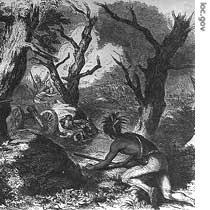
The French and Indians did not fight this way. They hid in the woods. They wore clothes that made them difficult to see. They shot at the British from behind trees. The British had more troops than the other side. But the French and Indians won the battle of Fort Duquesne. General Braddock was killed.

VOICE TWO:

Most of the French and Indian War was fought along two lakes in an area of New York state near the border with Canada. One was Lake George. The other, Lake Champlain north of Lake George. It reaches almost all the way to the city of Montreal in Canada.

These lakes provided the best way to move troops and supplies during the French and Indian war. Few roads existed in North America at that time. The military force, which controlled the lakes and rivers, controlled much of North America.

(MUSIC)

VOICE ONE:

The French had military bases in the cities of Quebec and Montreal. The British had military bases along New York's Hudson River. The area between them became the great battleground.

Fighting increased after the British defeated the French near Lake George in the last months of seventeen fifty-five. The French then built a new military base to control Lake Champlain and the surrounding area.

The French military base was at the southern end of Lake Champlain. They built a strong camp, the kind called a fort. They called it Fort Carillon.

The fort would control Lake Champlain and the area needed to reach the northern part of Lake George. The fort was designed to provide a strong defense against attack. The French built two big walls of logs, several meters apart. The area between the walls was filled with dirt. Later, a strong stone front was added. Troops inside the walls were well protected. The British built a similar fort at the southern end of Lake George. They called it Fort William Henry.

VOICE TWO:

France sent one of its best military commanders to take command of its troops in America. His name was the Marquis de Montcalm. General Montcalm attacked several British forts in seventeen fifty-seven. One of these was Fort William Henry on Lake George. The British commander was forced to surrender.

General Montcalm promised that the British troops would be treated fairly if they surrendered. But the Indian allies of the French did not honor the surrender agreement. They began to kill British soldiers and settlers. No one is sure how many people died. It could have been more than one thousand.

(MUSIC)

VOICE ONE:

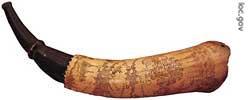
During the French and Indian War and the American Revolution, soldiers often marked their powder horns with maps and other images
In seventeen fifty-eight, a strong British force attacked Fort Carillon on Lake Champlain. General Montcalm was the French commander. Fort Carillon was strong enough that the smaller French force was able to defeat the bigger British force. The British withdrew, but attacked again the next year. This time the British commander was General Jeffery Amherst.

Amherst was successful. The British defeated the French. They changed the name of Fort Carillon to Fort Ticonderoga. It became an important military center in the French and Indian War. Fort Ticonderoga would also become important later, during America's war for independence.

VOICE TWO:

The Battle for Quebec was the turning point in the war. Britain and France signed a treaty to end it in Paris in seventeen sixty-three. The British had won. They took control of the lands that had been claimed by France.

Britain now claimed all the land from the east coast of North America to the Mississippi River. Everything west of that river belonged to Spain. France gave all its western lands to Spain to keep the British out. Indians still controlled most of the western lands, except for some Spanish colonies in Texas and New Mexico.

VOICE ONE:

Today, you can still visit the two forts that were so important in the French and Indian War. Little of the original buildings have survived. However, both have been re-built using the original designs. The area surrounding both forts is very beautiful, including the two lakes, Lake George and Lake Champlain.

Many people spend their holidays in this area enjoying the outdoors. The area includes one of America's national historical parks, Saratoga. It also includes the Lake George Beach State Park. Few people who visit the area stop to remember the terrible fighting that took place there two-hundred fifty years ago.

(MUSIC)

VOICE TWO:

This MAKING OF A NATION program was written by Nancy Steinbach and Paul Thompson. I'm Barbara Klein.

VOICE ONE:

And I'm Steve Ember. Read and listen to our programs at voaspecialenglish.com. Join us again at this time next week for another program about the history of the United States in Special English on the Voice of America.

11.22.2007

VOASE1121_The Making of a Nation

21 November 2007
American History Series: By 1750, Almost One in Four People in the Colonies Were Slaves

Download
Download

VOICE ONE:

This is Rich Kleinfeldt.

VOICE TWO:

And this is Sarah Long with THE MAKING OF A NATION, a VOA Special English program about the history of the United States.

Today, we tell about slavery, and how it affected the history of the United States.

(MUSIC)

VOICE ONE:

Slavery is one person controlling or owning another. Some history experts say it began following the development of farming about ten thousand years ago. People forced prisoners of war to work for them. Other slaves were criminals or people who could not re-pay money they owed.

Experts say the first known slaves existed in the Sumerian society of what is now Iraq more than five thousand years ago. Slavery also existed among people in China, India, Africa, the Middle East and the Americas. It expanded as trade and industry increased.

This increase created a demand for a labor force to produce goods for export. Slaves did most of the work. Most ancient people thought of slavery as a natural condition that could happen to anyone at any time. Few saw it as evil or unfair. In most cities, slaves could be freed by their owners and become citizens.

In later times, slaves provided the labor needed to produce products that were in demand. Sugar was one of these products. Italians established large sugar farms beginning around the twelfth century. They used slaves from Russia and other parts of Europe to do the work. By the year thirteen hundred, African blacks had begun to replace the Russian slaves. They were bought or captured from North African Arabs, who used them as slaves for years.

By the fifteen hundreds, Spain and Portugal had American colonies. The Europeans made native Indians work in large farms and mines in the colonies. Most of the Indians died from European diseases and poor treatment. So the Spanish and Portuguese began to bring in people from West Africa as slaves. France, Britain and the Netherlands did the same in their American colonies.

VOICE TWO:

In 1660, Charles II gave the Royal African Company the right to secure a trade monopoly in West Africa. From there, the company began supplying slaves to England's American colonies.
England's southern colonies in North America developed a farm economy that could not survive without slave labor.

Many slaves lived on large farms called plantations. These large farms produced important crops traded by the colony, crops such as cotton and tobacco. Each plantation was like a small village owned by one family. That family lived in a large house, usually facing a river. Many separate buildings were needed on a plantation. For example, a building was needed for cooking. And buildings were needed for workers to produce goods such as furniture that were used on the plantation.

The plantation business was farming. So there also were barns for animals and buildings for holding and drying crops. There was a house to smoke meat so could be kept safely. And there was a place on the river from which goods were sent to England on ships.

VOICE ONE:

The plantation owner controlled the farm and saw that it earned money. He supervised, fed and clothed the people living on it, including the slaves.

Big plantations might have two hundred slaves. They worked in the fields on crops that would be sold or eaten by the people who lived on the plantation. They also raised animals for meat and milk.

Field slaves worked very long and hard. They worked each day from the time the sun rose until it set. Many of these slaves lived in extremely poor conditions in small houses with no heat or furniture. Sometimes, five or ten people lived together in one room.

House slaves usually lived in the owner's house. They did the cooking and cleaning in the house. House slaves worked fewer hours than field slaves, but were more closely supervised by the owner and his family.

(MUSIC)

VOICE TWO:

Slaves preparing dried tobacco to be shipped to England from Jamestown
Laws approved in the southern colonies made it illegal for slaves to marry, own property or earn their freedom. These laws also did not permit slaves to be educated, or even to learn to read. But some owners permitted their slaves to earn their freedom, or gave them money for good work.

Other owners punished slaves to get them to work. These punishments included beatings, withholding food and threatening to sell members of a slave's family. Some plantation owners executed slaves suspected of serious crimes by hanging them or burning them alive.

History experts say that people who were rich enough to own many slaves became leaders in their local areas. They were members of the local governments. They attended meetings of the legislatures in the capitals of their colonies usually two times a year. Slave owners had the time and the education to greatly influence political life in the southern colonies, because the hard work on their farms was done by slaves.

VOICE ONE:

Today, most people in the world condemn slavery. That was not true in the early years of the American nation. Many Americans thought slavery was evil, but necessary. Yet owning slaves was common among the richer people in the early seventeen hundreds. Many of the leaders in the colonies who fought for American independence owned slaves. This was true in the northern colonies as well as the southern ones.

Benjamin Franklin
One example is the famous American diplomat, inventor and businessman Benjamin Franklin. He owned slaves for thirty years and sold them at his general store. But his ideas about slavery changed during his long life. Benjamin Franklin started the first schools to teach blacks and later argued for their freedom.

(MUSIC)

VOICE TWO:

Slavery did not become a force in the northern colonies mainly because of economic reasons. Cold weather and poor soil could not support such a farm economy as was found in the South. As a result, the North came to depend on manufacturing and trade.

Trade was the way colonists got the English goods they needed. It was also the way to earn money by selling products found in the New World. New England became a center for such trade across the seas. The people who lived there became shipbuilders so they could send the products to England. They used local wood to build the ships. They also sold wood and wood products. They became businessmen carrying goods around the world.

The New England shipbuilding towns near the Atlantic Ocean grew quickly as a result. The largest of these towns was Boston, Massachusetts. By seventeen twenty, it had more than ten thousand people. Only two towns in England were larger: London and Bristol.

More than twenty-five percent of the men in Boston had invested in shipping or worked in it. Ship captains and businessmen held most of the public offices.

VOICE ONE:

A document from the Pennsylvania Society for the Abolition of Slavery, signed by the group's president, Benjamin Franklin.
The American colonies traded goods such as whale oil, ginger, iron, wood, and rum, an alcoholic drink made from sugarcane. Ships carried these goods from the New England colonies to Africa. There, they were traded for African people.

The Africans had been captured by enemy tribesmen and sold to African slave traders. The New England boat captains would buy as many as they could put on their ships. The conditions on these ships were very cruel. The Africans were put in so tightly they could hardly move. Some were chained. Many killed themselves rather than live under such conditions.

Others died of sicknesses they developed on the ship. Yet many did survive the trip, and became slaves in the southern colonies, or in the Caribbean islands. Black slaves were needed to work on Caribbean sugar plantations. The southern American colonies needed them to work on the tobacco and rice plantations.

By seventeen fifty, almost twenty-five percent of the total number of people in the American colonies were black slaves. From the fifteen hundreds to the eighteen hundreds, Europeans sent about twelve million black slaves from Africa to America. Almost two million of them died on the way.

VOICE TWO:

History experts say English ships carried the greatest number of Africans into slavery. One slave ship captain came to hate what he was doing, and turned to religion. His name was John Newton. He stopped taking part in slave trade and became a leader in the Anglican Church. He is famous for having written this song, "Amazing Grace".

(MUSIC)

VOICE ONE:

This program was written by Nancy Steinbach and produced by Paul Thompson. This is Rich Kleinfeldt.

VOICE TWO:

And this is Sarah Long. Join us again next week for another Special English program about the history of the United States.

11.15.2007

VOASE1114_The Making of a Nation

14 November 2007
American History Series: Slavery Arrives as Colonial Expansion Heads South

Download
Download

VOICE ONE:

This is Rich Kleinfeldt.

VOICE TWO:

And this is Sarah Long with the MAKING OF A NATION, a VOA Special English program about the history of the United States.

Today, we finish the story about the first thirteen American colonies. We tell about how the southern colonies developed.

(MUSIC)

VOICE ONE:

The most northern of the southern colonies was Maryland. The king of England, Charles the First, gave the land between Virginia and Pennsylvania to George Calvert in sixteen thirty-two. George Calvert was also called Lord Baltimore. He was a Roman Catholic.

George Calvert wanted to start a colony because of religious problems in England. Catholics could not openly observe their religion. They also had to pay money to the government because they did not belong to the Anglican Church, which was the Church of England.

George Calvert never saw the colony that was called Maryland. He died soon after he received the documents. His son Cecil Calvert became the next Lord Baltimore, and received all the land. He had the power to collect taxes, fight wars, make laws and create courts in Maryland. Cecil Calvert named his brother Leonard as the colony's first governor.

Cecil Calvert, center, the second Lord of Baltimore, in a work by artist James Barry
Cecil Calvert believed that English Catholics could live in peace in Maryland with people who believed in Protestant religions. So he urged Catholics to leave England. To get more settlers, he permitted them to own their farms and gave them some power in local politics. Some Catholics did go to Maryland, but not as many as expected. Protestants were in the majority. In sixteen forty-nine, Lord Baltimore accepted a Toleration Act passed by the local government. It guaranteed freedom of religion, but only for Christians.

(MUSIC)

VOICE TWO:

King Charles the Second of England gave away more land in America in sixteen sixty-three. This time, he gave to eight English lords the land known as Carolina. It extended south from Virginia into an area known as Florida. Spain controlled Florida. Spain also claimed the southern part of Carolina.

Spanish, French and English settlers had tried to live in that area earlier. But they were not successful. But the eight new owners promised forty hectares of land to anyone who would go to Carolina to live. They also promised religious freedom. The first successful Carolina settlers left England in sixteen seventy. They built a town in an area where two rivers met. They called it Charles Town, for King Charles. Spanish ships attacked the port city many times, but the settlers kept them away.

The settlers planted all kinds of crops to see what would grow best. They found rice was just right for the hot, wet land. Their pigs and cattle did so well that settlers in Carolina started selling meat to the West Indies. Many of Charles Town's settlers came from Barbados, a port used in the West Indies slave trade. The settlers began buying black slaves to help grow the rice. By seventeen-oh-eight, more blacks than whites lived in southern Carolina. The work of slaves made possible a successful economy.

VOICE ONE:

Northern Carolina grew much more slowly than the southern part of the colony. Many settlers to this area were from nearby Virginia. People who did not agree with the Anglican Church were not welcome in Virginia. Some of them moved south to the northern part of Carolina. History experts say that the area that became North Carolina may have been the most democratic of all the colonies. The people generally did not get involved in each other’s lives. They permitted each other to live in peace. They faced danger together from pirates who made the North Carolina coast their headquarters.

Experts say the people in northern Carolina were independent thinkers. In sixteen seventy-seven, some of them rebelled against England. They did not like England's Navigation Acts. These laws forced people in Carolina to pay taxes to England on goods sold to other colonies. Some northern Carolina settlers refused to pay this tax. They even set up their own government and tried to break free of England. But the English soldiers in the colonies stopped the rebellion by arresting its leader.

The differences between the people of northern Carolina and southern Carolina became too great. The owners of the colony divided Carolina into two parts in seventeen twelve.

VOICE TWO:

James Oglethorpe was a rich member of Parliament who used his own money to settle the new colony of Georgia
The last English colony founded in the New World was Georgia. It was established in seventeen thirty-two, under King George the Second. Georgia was the idea of a man named James Oglethorpe. He wanted to solve the debtor problem in England. Debtors are people who cannot re-pay money they owe. At that time, debtors were placed in prison. This made it impossible for them to earn the money needed to pay their debts.

Oglethorpe wanted to create a colony where debtors could go instead of going to prison. He wanted it to be a place where people could have good lives. But not many debtors wanted to go to Georgia. The people who settled there were much like the people in the other colonies. They did not agree with all of Oglethorpe's ideas. They wanted to do things he did not believe were right, like drinking alcohol and owning slaves. The settlers won in the end. They did not accept Oglethorpe's ideas about how they should live.

Life was not easy in Georgia. Spaniards and pirates captured ships of all nations along the coast. Spain controlled Florida and also claimed Georgia and the Carolinas. Border fights were common. Oglethorpe lost all his money trying to establish Georgia. King George took control of the colony in seventeen fifty-two.

(MUSIC)

VOICE ONE:

As all these new colonies were being established nearby, the colony of Virginia was growing. A way of life was developing there that was very different from that found in the north. Most people in Virginia at this time were members of the Church of England. Religion was not as important a part of their lives as it was to the people in the north. In the New England colonies, the clergy were considered the most important people in town. In the southern colonies, rich land owners were more important.

People in Virginia did not live in towns, as people did in Massachusetts. They lived along rivers on small farms or on large farms called plantations. Living on a river made it easy to send goods to other nations by ship. Virginians were sending large amounts of tobacco to England on those ships. It was the crop that earned them the most money.

VOICE TWO:

Growing tobacco destroys the elements in the soil that support plant life. After a few years, nothing grows well on land that has been planted with tobacco. A farmer has to stop planting anything on the land every few years. That means he needs a lot of land. He also needs many workers. So tobacco farmers in Virginia began to buy land and workers.

At first, they bought the services of poor people who had no money or jobs. These people were called indentured servants. They made an agreement to work for a farmer for a period of four to seven years. Then they were freed to work for themselves.

Slaves preparing dried tobacco to be shipped to England from Jamestown
In sixteen nineteen, a Dutch ship brought some Africans to Jamestown. They had been kidnapped from their homes by African traders and sold to the ship's captain. He sold them to the Virginia settlers. Those first blacks may have been treated like indentured servants. Later, however, colonists decided to keep them as slaves so they would not have to continue paying for workers. Indians did not make good slaves because they could run away. Blacks could not. They had no place to go. Slowly, laws were approved in Virginia that made it legal to keep black people as slaves. By seventeen fifty, there were more Africans in Virginia than any other group.

VOICE ONE:

History experts continue to debate if slavery caused prejudice in America or prejudice caused slavery. No one knows the answer. Most Europeans of the seventeenth century felt they were better than African people. The reasons for this included the Africans' different customs, religion and the black color of their skin. Europeans believed the color black represented danger and death.

Slavery in the American south affected the history of the United States for many years. It divided the people and led to a great civil war. But slavery did not start in America. That will be our story next week.

VOICE TWO:

This MAKING OF A NATION program was written by Nancy Steinbach. This is Sarah Long.

VOICE ONE:

And this is Rich Kleinfeldt. Join us again next week for another VOA Special English program about the history of the United States.

11.08.2007

VOASE1107_The Making of a Nation

07 November 2007
American History Series: How a Desire for Religious Freedom or Land, or Both, Led to Colonies

Download
Download

VOICE ONE:

This is Rich Kleinfeldt.

VOICE TWO:

And this is Sarah Long with the MAKING OF A NATION, a VOA Special English program about the history of the United States.

(MUSIC)

Today, we tell about the movement of European settlers throughout northeastern America. And we tell how the separate colonies developed in this area.

VOICE ONE:

The Puritans were one of the largest groups from England to settle in the northeastern area called Massachusetts. They began arriving in sixteen thirty. The Puritans had formed the Massachusetts Bay Company in England. The king had given the company an area of land between the Charles and Merrimack rivers.

The Puritans were Protestants who did not agree with the Anglican Church. The Puritans wanted to change the church to make it more holy. They were able to live as they wanted in Massachusetts. Soon they became the largest religious group. By sixteen ninety, fifty thousand people were living in Massachusetts.

Puritans thought their religion was the only true religion and everyone should believe in it. They also believed that church leaders should lead the local government, and all people in the colony should pay to support the Puritan church. The Puritans thought it was the job of government leaders to tell people what to believe.

Some people did not agree with the Puritans who had become leaders of the colony. One of those who disagreed was a Puritan minister named Roger Williams.

VOICE TWO:

Roger Williams wrote several documents stating his views on religious liberty
Roger Williams believed as all Puritans did that other European religions were wrong. He thought the Native Indian religions were wrong too. But he did not believe in trying to force others to agree with him. He thought that it was a sin to punish or kill anyone in the name of Christianity. And he thought that only church members should pay to support their church.

Roger Williams began speaking and writing about his ideas. He wrote a book saying it was wrong to punish people for having different beliefs. Then he said that the European settlers were stealing the Indians' land. He said the king of England had no right to permit people to settle on land that was not his, but belonged to the Indians.

The Puritan leaders of the Massachusetts Bay Colony forced Roger Williams to leave the colony in sixteen thirty-six. He traveled south. He bought land from local Indians and started a city, Providence. The Parliament in England gave him permission to establish a new colony, Rhode Island, with Providence as its capital. As a colony, Rhode Island accepted people of all religious beliefs, including Catholics, Quakers, Jews and even people who denied the existence of God.

Roger Williams also believed that governments should have no connection to a church. This idea of separating church and state was very new. Later it became one of the most important of all America's governing ideas.

(MUSIC)

VOICE ONE:

Other colonies were started by people who left Massachusetts to seek land. One was Connecticut. A group led by Puritan minister Thomas Hooker left Boston in sixteen thirty-six and went west. They settled near the Connecticut River. Others soon joined them.

Other groups from Massachusetts traveled north to find new homes. The king of England had given two friends a large piece of land in the north. The friends divided it. John Mason took what later became the colony of New Hampshire. Ferdinando Gorges took the area that later became the state of Maine. It never became a colony, however. It remained a part of Massachusetts until after the United States was created.

VOICE TWO:

The area known today as New York State was settled by the Dutch. They called it New Netherland. Their country was the Netherlands. It was a great world power, with colonies all over the world. A business called the Dutch West India Company owned most of the colonies.

The Dutch claimed American land because of explorations by Henry Hudson, an Englishman working for the Netherlands. The land the Dutch claimed was between the Puritans in the north and the Anglican tobacco farmers in the south.

The Dutch were not interested in settling the territory. They wanted to earn money. The Dutch West India Company built trading posts on the rivers claimed by the Netherlands. People in Europe wanted to buy goods made from the skins of animals trapped there.

In sixteen twenty-six, the Dutch West India Company bought two islands from the local Indians. The islands are Manhattan Island and Long Island. Traditional stories say the Dutch paid for the islands with some trade goods worth about twenty-four dollars.

The Dutch West India Company tried to find people to settle in America. But few Dutch wanted to leave Europe. So the colony welcomed people from other colonies, and other countries. These people built a town on Manhattan Island. They called it New Amsterdam. It was soon full of people who had arrived on ships from faraway places. It was said you could hear as many as eighteen different languages spoken in New Amsterdam.

In sixteen fifty-five, the governor of New Netherland took control of a nearby Swedish colony on Delaware Bay. In sixteen sixty-four, the English did the same to the Dutch. The English seized control of New Amsterdam and called it New York. That ended Dutch control of the territory that now is the states of New York, New Jersey and Delaware.

(MUSIC)

VOICE ONE:

Most of the Dutch in New Amsterdam did not leave. The English permitted everyone to stay. They let the Dutch have religious freedom. The Dutch were just not in control any more.

The Duke of York owned the area now. He was the brother of King Charles the Second of England. The king gave some of the land near New York to two friends, Sir George Carteret and Lord John Berkeley. They called it New Jersey, after the English island where Carteret was born.

The two men wrote a plan of government for their colony. It created an assembly that represented the settlers. It provided for freedom of religion. Men could vote in New Jersey whatever their religion. Soon, people from all parts of Europe were living in New Jersey. Then King Charles took control of the area. He sent a royal governor to rule. But the colonists were permitted to make their own laws through the elected assembly.

The king of England did the same in each colony he controlled. He collected taxes from the people who lived there, but permitted them to govern themselves.

(MUSIC)

VOICE TWO:

One religious group that was not welcome in England was the Quakers. Quakers call themselves Friends. They believe that each person has an inner light that leads them to God. Quakers believe they do not need a religious leader to tell them what is right. So, they had no clergy.

Quakers believe that all people are equal. The Quakers in England refused to recognize the king as more important than anyone else. They also refused to pay taxes to support the Anglican Church. Quakers believe that it is always wrong to kill. So they would not fight even when they were forced to join the army. They also refuse to promise loyalty to a king or government or flag or anyone but God.

The English did not like the Quakers for all these reasons. Many Quakers wanted to leave England, but they were not welcome in most American colonies. One Quaker changed this. His name was William Penn.

VOICE ONE:

William Penn came to America in 1682. He established Pennsylvania as a place where people could enjoy freedom of religion.
William Penn was not born a Quaker. He became one as a young man. His father was an Anglican, and a good friend of the king.

King Charles borrowed money from William's father. When his father died, William Penn asked that the debt be paid with land in America. In sixteen eighty-one, the king gave William Penn land which the King's Council named Pennsylvania, meaning Penn's woods.

The Quakers now had their own colony. It was between the Puritans in the north and the Anglicans in the south. William Penn said the colony should be a place where everyone could live by Quaker ideas.

That meant treating all people as equals and honoring all religions. It also meant that anyone could be elected. In most other colonies, people could believe any religion, but they could not vote or hold office unless they were a member of the majority church. In Pennsylvania, all religions were equal.

(MUSIC)

VOICE TWO:

This MAKING OF A NATION program was written by Nancy Steinbach and produced by Paul Thompson. This is Sarah Long.

VOICE TWO:

And this is Rich Kleinfeldt. Join us again next week for another VOA Special English program about the history of the United States.
11.03.2007

VOASE1031_The Making of a Nation

31 October 2007
American History Series: A Clash of Cultures in the New World

Download
Download

VOICE ONE:

This is Rich Kleinfeldt.

VOICE TWO:

And this is Ray Freeman with the MAKING OF A NATION, a VOA Special English program about the history of the United States.
(MUSIC)

VOICE ONE:

Our story today is a sad one. It is the story of a clash of peoples, religions, ideas, and cultures. It is a story of strongly held ideas and a lack of compromise.

It is the story of the relations between Europeans and the natives who had lived for thousands of years in the area we now call North America.

VOICE TWO:

Teton Sioux horse races in South Dakota. Artwork by Karl Bodmer from the 1830s.
Many different Native American groups lived on the East Coast of what would become United States. They spoke many different languages. Some were farmers, some were hunters. Some fought many wars, others were peaceful.

These groups are called tribes. Their names are known to most Americans...the Senecas, the Mohawks, the Seminole, the Cherokee to name only a few.

VOICE ONE:

These tribes had developed their own cultures many years before the first European settlers arrived. Each had a kind of religion, a strong spiritual belief. Many tribes shared a similar one.

The Indians on the East Coast shared a highly developed system of trade. Researchers say different tribes of Native Americans traded goods all across the country.

VOICE TWO:

The first recorded meetings between Europeans and the natives of the East Coast took place in the fifteen hundreds. Fishermen from France and the Basque area of Spain crossed the Atlantic Ocean. They searched for whales along the east coast of North America. They made temporary camps along the coast. They often traded with the local Indians.

The Europeans often paid Indians to work for them. Both groups found this to be a successful relationship. Several times different groups of fishermen tried to establish a permanent settlement on the coast, but the severe winters made it impossible. These fishing camps were only temporary.

VOICE ONE:

The first permanent settlers in New England began arriving in sixteen twenty. They wanted to live in peace with the Indians. They needed to trade with them for food. The settlers also knew that a battle would result in their own, quick defeat because they were so few in number.

Yet, problems began almost immediately. Perhaps the most serious was the different way the American Indians and the Europeans thought about land. This difference created problems that would not be solved during the next several hundred years.

(MUSIC)

VOICE TWO:

Land was extremely important to the European settlers. In England, and most other countries, land meant wealth. Owning large amounts of land meant a person had great wealth and political power.

Many of the settlers in this new country could never have owned land in Europe. They were too poor. And they belonged to minority religious groups. When they arrived in the new country, they discovered no one seemed to own the huge amounts of land.

Companies in England needed to find people willing to settle in the new country. So they offered land to anyone who would take the chance of crossing the Atlantic Ocean. For many, it was a dream come true. It was a way to improve their lives. The land gave them a chance to become wealthy and powerful.

VOICE ONE:

Calender of 37 months, 1889-92, kept on an animal skin by a Kiowa Indian
American Indians believed no person could own land. They believed, however, that anyone could use it. Anyone who wanted to live on and grow crops on a piece of land was able to do so.

The American Indians lived within nature. They lived very well without working very hard. They were able to do this because they understood the land and their environment. They did not try to change the land. They might farm in an area for a few years. Then they would move on. They permitted the land on which they had farmed to become wild again.

They might hunt on one area of land for some time, but again they would move on. They hunted only what they could eat, so the numbers of animals continued to increase. The Indians understood nature and made it work for them.

VOICE TWO:

The first Europeans to settle in New England in the northeastern part of America were few in number. They wanted land. The Indians did not fear them. There was enough land for everyone to use and plant crops. It was easy to live together. The Indians helped the settlers by teaching them how to plant crops and survive on the land.

But the Indians did not understand that the settlers were going to keep the land. This idea was foreign to the Indians. It was like to trying to own the air, or the clouds.

As the years passed, more and more settlers arrived, and took more and more land. They cut down trees. They built fences to keep people and animals out. They demanded that the Indians stay off their land.

(MUSIC)

VOICE ONE:

Religion was another problem between the settlers and the Indians. The settlers in New England were very serious about their Christian religion. They thought it was the one true faith and all people should believe in it. They soon learned that the Indians were not interested in learning about it or changing their beliefs.

Many settlers came to believe that Native Americans could not be trusted because they were not Christians. The settler groups began to fear the Indians. They thought of the Indians as a people who were evil because they had no religion. The settlers told the Indians they must change and become Christians. The Indians did not understand why they should change anything.

VOICE TWO:

The European settlers failed to understand that the Native American Indians were extremely religious people with a strong belief in unseen powers. The Indians lived very close to nature. They believed that all things in the universe depend on each other. All native tribes had ceremonies that honored a creator of nature. American Indians recognized the work of the creator of the world in their everyday life.

VOICE ONE:

Other events also led to serious problems between the Native Americans and the settlers. One serious problem was disease. The settlers brought sickness with them from Europe. For example, the disease smallpox was well known in Europe. Some people carried the bacteria that caused smallpox, although they did not suffer the sickness itself.

Smallpox was unknown to Native Americans. Their bodies' defense systems could not fight against smallpox. It killed whole tribes. And, smallpox was only one such disease. There were many others.

(MUSIC)

VOICE TWO:

The first meetings between settlers and Native Americans were the same in almost every European settlement on the East Coast of America. The two groups met as friends. They would begin by trading for food and other goods.

In time, however, something would happen to cause a crisis. Perhaps a settler would demand that an Indian stay off the settler's land. Perhaps a settler, or Indian, was killed. Fear would replace friendship. One side or the other would answer what they believed was an attack. A good example of this is the violent clash called King Philip's War.

VOICE ONE:

Matacom was a leader of the Wampanoag tribe that lived in the
northern-most colonies. He was known to the English as King Philip. Without the help of his tribe, the first European settlers in that area might not have survived their first winter. The Wampanoag Indians provided them with food. They taught the settlers how to plant corn and other food crops. The two groups were very friendly for several years.

As the years passed, however, fear and a lack of understanding increased. Matacom's brother died of a European disease. Matacom blamed the settlers. He also saw how the increasing numbers of settlers were changing the land. He believed they were destroying it.

VOICE TWO:

One small crisis after another led to the killing of a Christian Indian who lived with the settlers. The settlers answered this by killing three Indians. A war quickly followed. It began in sixteen seventy-five and continued for almost two years. It was an extremely cruel war. Men, women and children on both sides were killed. Researchers believe more than six hundred settlers were killed. They also say as many as three thousand Native Americans died in the violence.

VOICE ONE:

History experts say the tribe of Indians called the Narraganset were the true victims of King Philip's War. The Narraganset were not involved in the war. They did not support one group or the other. However, the settlers killed almost all the Narraganset Indians because they had learned to fear all Indians.

This fear, lack of understanding and the failure to compromise were not unusual. They strongly influenced the European settlers relations with Native Americans in all areas of the new country.

(MUSIC)

VOICE TWO:

This MAKING OF A NATION program was written and produced by Paul Thompson. This is Ray Freeman.

VOICE ONE:

And this is Rich Kleinfeldt. Join us again next week for another VOA Special English program about the history of the United States.

11.01.2007

VOASE1024_The Making of a Nation

24 October 2007
American History Series: Buffalo, 'Mystery Dogs' (Horses) and the Lives of the Plains Indians

Download
Download

VOICE ONE:

This is Rich Kleinfeldt.

VOICE TWO:

And this is Sarah Long with the MAKING OF A NATION, a VOA Special English program about the history of the United States. Today, we tell about early Native Americans.

VOICE ONE:

Scientists believe that the native peoples of America came here thousands of years ago during the last ice age. These people settled the land from the cold northern areas to the extreme end of South America.

As the groups of people settled different parts of the land, they developed their own languages, their own cultures and their own religions. Each group's story is important in the history of the Americas. However, it is perhaps the tribes of the central part of the United States that are most recognized. They will be our story today.

(MUSIC)

VOICE TWO:

Merriwether Lewis and William Clark

In eighteen-oh-four, Merriwether Lewis and William Clark led a group of explorers to the Pacific Ocean. They were the first educated Americans to see some of the native tribes of the Great Plains.

And they were the first white people these Native American people had ever seen.

When the group of explorers neared the eastern side of the great Rocky Mountains, they met with a tribe of Indians called the Shoshoni. Merriwether Lewis was the first to see them.

Let us imagine we are with Merriwether Lewis near the Rocky Mountains almost two hundred years ago. Across a small hill, a group of sixty Shoshoni men are riding toward us.

(MUSIC)

VOICE ONE:

The first thing we see is that these men are ready for war. Each is armed with a bow and arrows. Some carry long poles with a sharp knife on the end.

They are riding very fast. Some horses seem to be without riders. But a closer look shows that the men are hanging off the sides, or under the horse’s neck. They are using the horses' bodies as protection.

The horses are painted with many different designs that use blue, black, red or other colors. Later we learn that each design has a special meaning for the man who owns the horse. Each one tells a story.

For example, the man riding one horse is a leader during battle. Another has killed an enemy in battle. One of the designs protects the horse and rider.

VOICE TWO:

As they come nearer, the Shoshoni group sees that we are not ready for war. They slow their horses but are still very careful. Merriwether Lewis holds up a open hand as a sign of peace. The leader of the Shoshoni does the same. They come closer.

The Shoshoni are dressed in clothes made from animal skin. Most of these skins are from deer or the American buffalo. The shirts they wear have many designs, and tell stories like the designs on the horses. One shows a man has fought in a battle. Another shows a man has been in many raids to capture horses. Still another shows the man saved the life of a friend.

VOICE ONE:

Captain Lewis smiles at these men. He again makes a hand sign that means peace. The signs are now returned. Lewis and the Shoshoni chief cannot speak each other's language. They can communicate using hand signs.

VOICE TWO:

One young Shoshoni man comes near. He drops to the ground from his horse. He is tall and looks strong. His hair is black in color and long. He wears one long bird feather in the back of his hair. Some of his hair is held in place by animal fur.

His arms have been painted with long lines. We learn that each line represents a battle. There are many lines. But we leave the Shoshoni without him adding another one.

(MUSIC)

VOICE ONE:

The Shoshoni were only one of many tribes of native people who lived in the Great Plains area. The life, culture and society of these tribes developed because of the land that was their home.

The Great Plains today is still huge. Even in a car, traveling at one hundred kilometers an hour, it can take two long days of driving to cross the Great Plains. The plains reach from several hundred kilometers north in Canada across the middle of the continent to Mexico in the south.

In the East, the Great Plains begin near the Mississippi River and go west to the huge Rocky Mountains. It is the center of the United States. There are big rivers here, deserts and mountains. Other areas are so flat that a person can see for hundreds of kilometers. Millions of kilometers of this land were once covered by a thick ocean of grass.

VOICE TWO:

'Buffalo Lancing in the Snow Drifts -- Sioux' by artist George Catlin
The grass provided food for an animal that made possible the culture of the Indians of the Great Plains. The grass fed the bison, the American buffalo.

The buffalo was the center of native Indian culture in the Great Plains. The huge animal provided meat for the Indians. But it was much more than just food. It was an important part of the religion of most of the native people in the Great Plains.

The Lakota tribe is one of the people of the Great Plains. The Lakota are sometimes called the Sioux. They believed that everything necessary to life was within the buffalo. Another Plains tribe, the Blackfeet, called the animal "My home and my protection."

(MUSIC)

VOICE ONE:

The back of the huge buffalo provided thick skin that was used to make homes for the Plains Indians. Other parts were made into clothing. Still other parts became warm blankets. Buffalo bones were made into tools. Nothing of the animal was wasted.

No one knows how many buffalo were in North America when Merriwether Lewis first met the Shoshoni. But experts say it was probably between sixty million to seventy-five million.

VOICE TWO:

Another animal also helped make possible the Indian cultures of the Great Plains. Native Americans first called these animals mystery dogs, or big dogs. They had no word for this animal in their language. We know it as the horse.

No horses existed in North America before the Spanish arrived in the fifteen hundreds in what is now the southern part of the United States. Native peoples hunted, moved and traveled by foot. Traveling long distances was difficult, so was hunting buffalo.

The horse greatly changed the life of all the people of the Great Plains. It gave them a method of travel. It provided a way to carry food and equipment. It made it easier and safer to follow and hunt the buffalo. The horse made it possible to attack an enemy far away and return safely. The number of horses owned became the measure of a tribe's wealth.

VOICE ONE:

Spanish settlers rode horses to the small town of Santa Fe in what is now the southwestern state of New Mexico. They arrived there in about the year sixteen-oh-nine.

It is not known how native peoples in Santa Fe got the first horses in the country. Perhaps they traded for them. Perhaps they captured them in an attack. Many tribes soon were trading and capturing horses.

By the seventeen fifties, all the tribes of the Great Plains had horses. They had become experts at raising, training and riding horses. They became experts at horse medicine.

Each Indian of the Great Plains could ride a horse by the age of five. As an adult, a young man would have a special horse for work. Another horse would be trained for hunting. And another would be trained for war. An Indian warrior's success depended upon how closely he and his horses worked together.

(MUSIC)

VOICE TWO:

William Fisk painted this picture of George Catlin in 1849
George Catlin was an artist who traveled a great deal in the early American west. He painted many beautiful pictures of American Indians. Mister Catlin said the Plains Indian was the greatest horse rider the world has ever known. He said the moment an Indian rider laid a hand on his horse he became part of the animal.

VOICE ONE:

The buffalo and horse were extremely important to the Plains Indian. Because the horse made hunting easier, more time could be spent on things like art. The Plains Indians began to make designs on their clothing, and on special blankets their horses wore. Even common objects were painted with designs.

VOICE TWO:

The coming of white settlers to the Great Plains was the beginning of the end of the buffalo and horse culture of the American Indians. Settlers did not want buffalo destroying their crops. The buffalo were killed. By the year eighteen eighty-five, the Indians of the Great Plains were mostly restricted to area of land called reservations.

VOICE ONE:

Many of the Great Plains tribes that survive today work hard to keep their traditional cultures. They produce art, music, and clothing. They keep alive the memory of these people who added greatly to the history of America.

(MUSIC)

VOICE TWO:

This MAKING OF A NATION program was written by Paul Thompson. This is Sarah Long.

VOICE ONE:

And this is Rich Kleinfeldt. Join us again next week for another VOA Special English program about the history of the United States.

10.23.2007

VOASE1017_The Making of a Nation

17 October 2007
American History Series: A Difficult Life for English Settlers

Download
Download

VOICE ONE:

This is Rich Kleinfeldt.

VOICE TWO:

And this is Sarah Long with the MAKING OF A NATION, a VOA Special English program about the history of the United States. Today, we tell about the first permanent English settlements in North America.

(MUSIC)

VOICE ONE:

England was the first country to compete with Spain for claims in the New World, although it was too weak to do this openly at first. But Queen Elizabeth of England supported such explorations as early as the fifteen seventies.

Sir Humphrey Gilbert led the first English settlement efforts. He did not establish any lasting settlement. He died as he was returning to England.

Gilbert's half brother Sir Walter Raleigh continued his work. Raleigh sent a number of ships to explore the east coast of North America. He called the land Virginia to honor England's unmarried Queen Elizabeth.

In fifteen eighty-five, about one-hundred men settled on Roanoke Island, off the coast of the present day state of North Carolina. These settlers returned to England a year later. Another group went to Roanoke the next year. This group included a number of women and children. But the supply ships Raleigh sent to the colony failed to arrive. When help got there in fifteen-ninety, none of the settlers could be found.

History experts still are not sure what happened. Some research suggests that at least some of the settlers became part of the Indian tribe that lived in the area.

VOICE TWO:

One reason for the delay in getting supplies to Roanoke was the attack of the Spanish Navy against England in fifteen eighty-eight. King Phillip of Spain had decided to invade England. But the small English ships combined with a fierce storm defeated the huge Spanish fleet. As a result, Spain was no longer able to block English exploration.

England discovered that supporting colonies so far away was extremely costly. So Queen Elizabeth took no more action to do this. It was not until after her death in sixteen-oh-three that England began serious efforts to start colonies in America.

(MUSIC)

VOICE ONE:

In sixteen-oh-six, the new English King, James the First, gave two business groups permission to establish colonies in Virginia, the area claimed by England. Companies were organized to carry out the move.

View of historic Jamestown
The London Company sent one hundred settlers to Virginia in sixteen-oh-six. The group landed there in May, sixteen-oh-seven and founded Jamestown. It was the first permanent English colony in the new world.

The colony seemed about to fail from the start. The settlers did not plant their crops in time so they soon had no food. Their leaders lacked the farming and building skills needed to survive on the land. More than half the settlers died during the first winter.

VOICE TWO:

The businessmen controlling the colony from London knew nothing about living in such a wild place. They wanted the settlers to search for gold, and explore local rivers in hopes of finding a way to the East. One settler knew this was wrong. His name was Captain John Smith. He helped the colonists build houses and grow food by learning from the local Indians. Still, the Jamestown settlers continued to die each year from disease, lack of food and Indian attacks.

The London Company sent six thousand settlers to Virginia between sixteen-oh-six and sixteen twenty-two. More than four thousand died during that time.

(MUSIC)

VOICE ONE:

A cooking fire in a re-creation of a Powhatan Indian village
History experts say that all the settlers surely would have died without the help of the local Powhatan Indians. The Indians gave the settlers food. They taught them how to live in the forest. And the Powhatan Indians showed the settlers how to plant new crops and how to clear the land for building.

The settlers accepted the Indians' help. Then, however, the settlers took whatever else they wanted by force. In sixteen twenty-two, the local Indians attacked the settlers for interfering with Indian land. Three hundred forty settlers died. The colonists answered the attack by destroying the Indian tribes living along Virginia's coast.

The settlers recognized that they would have to grow their own food and survive on their own without help from England or anyone else. The Jamestown colony was clearly established by sixteen twenty-four. It was even beginning to earn money by growing and selling a new crop, tobacco.

VOICE TWO:

The other early English settlements in North America were much to the north of Virginia, in the present state of Massachusetts. The people who settled there left England for different reasons than those who settled in Jamestown. The Virginia settlers were looking for ways to earn money for English businesses. The settlers in Massachusetts were seeking religious freedom.

(MUSIC)

VOICE ONE:

King Henry the Eighth of England had separated from the Roman Catholic Church. His daughter, Queen Elizabeth, established the Protestant religion in England. It was called the Church of England, or the Anglican Church. The Anglican Church, however, was similar to that of the Roman Catholic Church.

Not all Protestants liked this. Some wanted to leave the Anglican Church and form religious groups of their own. In sixteen-oh-six, members of one such group in the town of Scrooby did separate from the Anglican Church. About one hundred twenty-five people left England for Holland. They found problems there too, so they decided to move again...to the New World.

These people were called pilgrims, because that is the name given to people who travel for religious purposes.

VOICE TWO:

An artist's depiction of the Mayflower
About thirty-five pilgrims were among the passengers on a ship called the Mayflower in sixteen twenty. It left England to go to Virginia. But the Mayflower never reached Virginia. Instead, it landed to the north, on Cape Cod Bay. The group decided to stay there instead of trying to find Jamestown.

The pilgrims and the others on the Mayflower saw a need for rules that would help them live together peacefully. They believed they were not under English control since they did not land in Virginia. So they wrote a plan of government, called the Mayflower Compact. It was the first such plan ever developed in the New World.

They elected a man called William Bradford as the first governor of their Plymouth Colony. We know about the first thirty years of the Plymouth Colony because William Bradford described it in his book, Of Plymouth Plantation.

As happened in Jamestown, about half the settlers in Plymouth died the first winter. The survivors were surprised to find an Indian who spoke English. His name was Squanto. He had been kidnapped by an English sea captain and had lived in England before returning to his people.

The Pilgrims believed Squanto was sent to them from God. He made it possible for them to communicate with the native people. He showed them the best places to fish, what kind of crops to plant and how to grow them. He provided them with all kinds of information they needed to survive. The settlers invited the Indians to a feast in the month of November to celebrate their successes and to thank Squanto for his help. Americans remember that celebration every year when they observe the Thanksgiving holiday.

(MUSIC)

VOICE ONE:

Other English settlers began arriving in the area now called New England. One large group was called the Puritans. Like the pilgrims, the Puritans did not agree with the Anglican Church. But they did not want to separate from it. The Puritans wanted to change it to make it more holy. Their desire for this change made them unwelcome in England.

The first ship carrying Puritans left England for America in sixteen thirty. By the end of that summer, one thousand Puritans had landed in the northeastern part of the new country. The new English King, Charles, had given permission for them to settle the Massachusetts Bay area.

VOICE TWO:

The Puritans began leaving England in large groups. Between sixteen thirty and sixteen forty, twenty thousand sailed for New England. They risked their lives on the dangerous trip. They wanted to live among people who believed as they did, people who honored the rules of the Bible. Puritans believed that the Bible was the word of God.

The Puritans and other Europeans, however, found a very different people in the New World. They were America's native Indians. That will be our story next week.

(MUSIC)

VOICE ONE:

This MAKING OF A NATION program was written by Nancy Steinbach. This is Rich Kleinfeldt

VOICE TWO:

And this is Sarah Long. Join us again next week for another Voice of America Special English program about the history of the United States.