7.19.2007

VOASE0718_Education Report

18 July 2007
Evidence for School Uniform Policies in US Seen as Weak

Download
Download

This is the VOA Special English Education Report.

In nineteen ninety-nine, twelve percent of public elementary schools in the United States required students to wear uniforms. Just three years later, estimates were almost double that.

Students leave a Cleveland, Ohio, high school in January 2006. A study of six big-city Ohio public schools showed students who were required to wear uniforms had improved graduation, behavior and attendance rates. Academic performance was unchanged.
Some middle and high schools have also joined the movement. Yet studies find mixed results from requiring uniforms. And some schools have turned away from such policies.

Supporters believe dressing the same creates a better learning environment and safer schools. The school district in Long Beach, California, was the first in the country to require uniforms in all elementary and middle schools.

That was in nineteen ninety-four. The example helped build national interest in uniforms as a way to deal with school violence and improve learning.

Findings in Long Beach suggested that the policy resulted in fewer behavior problems and better attendance. But researcher Viktoria Stamison has looked at those findings. She says they were based only on opinions about the effects of uniforms.

She says other steps taken at the same time to improve schools in Long Beach and statewide could have influenced the findings. The district increased punishments for misbehavior. And California passed a law to reduce class sizes.

Her report is among several in a book published last year called "Uniforms in Public Schools: A Decade of Research and Debate."

In Florida, for example, researcher Sharon Pate found that uniforms seemed to improve behavior and reduce violence. In Texas, Eloise Hughes found fewer discipline problems among students required to wear uniforms, but no effect on attendance.

Sociologist David Brunsma has studied school uniform policies since nineteen ninety-eight. He collected the reports in the book. In his own study, he found that reading and mathematics performance dropped after a school in rural Pennsylvania required uniforms.

Political and community pressures may persuade schools to go to uniforms to improve learning. But David Brunsma and others believe there is not enough evidence of a direct relationship. In fact, he says requiring uniforms may even increase discipline problems.

But researchers also say studies of uniform policies are often scientifically limited. They say more work is needed to get better information.

And that's the VOA Special English Education Report, written by Nancy Steinbach. For more on this debate, go to voaspecialenglish.com. I'm Steve Ember.

7.18.2007

US Senate Debates Plan to Withdraw Troops from Iraq in Marathon Session


17 July 2007

Download

In the U.S. Senate, Democratic leaders are holding a rare round-the-clock session to press Republicans to vote for a proposal calling for a withdrawal of U.S. troops from Iraq. Republican leaders are using procedural tactics to block the measure from moving forward on the Senate floor. VOA's Deborah Tate reports from Capitol Hill.

US troops during a mission in Baquba, 04 Jul 2007
Senators are debating a plan, proposed as an amendment to a defense bill, that calls for a U.S. troop pullout from Iraq to begin within 120 days and completed by next April.

Senator Jack Reed, a Rhode Island Democrat, is a key sponsor.

"The Bush administration's current policy is straining our military, inhibiting our ability to fight the war on terrorism, diminishing our standing in the international community, and rapidly losing the support of the American public," he said. "In sum, it is a policy that cannot be sustained."

Senator John McCain, 10 July 2007
But Republican opponents argue that withdrawing U.S. troops from Iraq before Iraqis are able to defend their own country would only lead to more violence, and would hand a victory to terrorists.

"If we leave Iraq prematurely, jihadists around world would interpret the withdrawal as their great victory against our great power," said Senator John McCain, an Arizona Republican.

But Senator Olympia Snowe of Maine, one of a few Republicans who support the measure, says the proposal does not call for a premature withdrawal.

Republican Sen. Olympia Snowe, second from left, accompanied by fellow Senators, discusses war in Iraq during a news conference on Capitol Hill in Washington, 17 July 2007
"It is a redeployment, a reduction in forces, a change in mission, for example, to engage in counterinsurgency against al-Qaida," she noted. "I think this is the most reasoned, reasonable approach. It is not rash."

Snowe favors a change in U.S. strategy in Iraq because, she argues, the Iraqi government has not done enough toward establishing a stable unity government.

Supporters of the troop withdrawal plan say more than 50 senators, a majority in the 100-member chamber, back the measure.

But they acknowledge that they lack the 60 votes necessary under Senate rules to overcome Republican efforts to block the legislation. A vote to limit debate and allow an up-or-down vote on the troop withdrawal measure scheduled Wednesday is expected to fail.

Still, Senate Majority Leader Harry Reid of Nevada says he hopes the round-the-clock session could alter the vote's outcome.

Senate Majority Leader Harry Reid (r), followed by Sen. Charles Schumer, center, and Sen. Richard Durbin, arrives for a news conference on Capitol Hill in Washington, 16 July 2007
"Will the all-night session change any votes? I hope so, because it will focus attention on the obstructionism of the Republicans," he said.

At the White House, spokesman Tony Snow views the marathon Senate session as pure political theater.

"The idea of going through the gesture of having late night, all-night meeting is highly unusual," he said. "You think, okay, this might be kind of interesting, so let's take it for the spectator event it is."

The White House has been urging lawmakers to wait to assess the situation in Iraq until the top U.S. commander in Iraq, General David Petraeus, briefs Congress in September.

Despite the gridlock on the troop withdrawal amendment, lawmakers did vote 94 to 3 in favor of a Republican-sponsored, non-binding resolution saying the Senate should not pass legislation that would undermine the U.S. military's ability to prevent a failed state in Iraq.

US Supports Pakistani Government Moves Against Extremists


17 July 2007

Download

The Bush administration said Tuesday the United States is prepared to back Pakistani government actions against extremism with as a much as $1 billion in economic and military aid over the next several years. Much of the money would help Islamabad authorities assert control in lawless tribal areas bordering Afghanistan. VOA's David Gollust reports from the State Department.

Richard Boucher (file photo)
The State Department's top official for South Asia says the Pakistani government has made an irrevocable commitment against extremists with its latest actions, and he says the United States is ready to support it long-term as it tries to build a moderate democratic Islamic state.

The comments by Assistant Secretary of State for South and Central Asian Affairs Richard Boucher follow the Pakistani government's use of force earlier this month to end the long-running militant occupation of Islamabad's Red Mosque compound, and new pledges to drive al-Qaida and other foreign forces from the tribal areas.

Boucher, best known for his years as the State Department's chief spokesman, said the action at the Red Mosque shows the government of President Pervez Musharraf is prepared to move against what he termed a "dangerous militancy" that has come to "infect" various areas and parts of Pakistani society:

"Clearing out the mosque and the extremism there was a bold move, a decisive move," said Boucher. "It may have been a long time coming after a lot of provocation, but that I think reflects a certain concern about the women and children inside. But now having dealt with the mosque, it's pretty much, you know, crossing a line and there's no going back."

Pervez Musharraf (file photo)
Boucher's appearance coincided with release of a White House intelligence report that said al-Qaida made a resurgence in the tribal areas under a deal Mr. Musharraf made with local chiefs last year withdrawing troops and allowing them to police the region.

The assistant secretary said the Pakistani leader is now making tough choices to deal with al-Qaida and the Taleban in frontier provinces, while maintaining a commitment to political reform in the run-up to parliamentary elections later this year:

"He's shown the determination and the authority and the ability to deal with some of these very difficult situations," said Boucher. "He's also shown the determination to bring about the democratic transition that he understands, and we understand, is important to the long-term success of Pakistan as a moderate, modern Muslim nation. So we have no problems working with him."

Boucher said the United States plans to spend $750 million over five years on education, health and economic projects in the tribal areas in support of a Pakistani program to integrate the remote region into the national economy.

He said the Bush administration hopes to find an additional $300 million or more to help revamp the Pakistani army's 85,000-member Frontier Corps that patrols the border region.

Boucher said while civilian aid may offer the best long-term solution to combating the extremists, some are very violent and will probably have to be dealt with militarily.

Libya Commutes Medics' Death Sentence in AIDS Case


17 July 2007

Download

The death sentence of five Bulgarian nurses and a Palestinian doctor accused of infecting hundreds of Libyan children with the AIDS virus, HIV, has been commuted to life in prison. Sabina Castelfranco reports from Rome the Bulgarians' effort now is to get the nurses repatriated.

The ruling came after the families of the children each received one million dollars in compensation.

The families agreed to drop their demand for the execution of five Bulgarian nurses and a Palestinian doctor charged with having infected with HIV more 400 Libyan children at a hospital in the northeastern coastal city of Benghazi.

Bulgarian Foreign Minister Ivailo Kalfin called the ruling "a huge step in the right direction."

International experts and outside scientific reports have said for years that the children were contaminated as a result of unhygienic conditions in the Libyan hospital.

Libyan security guards stand in front of the dock during the trial of five Bulgarian nurses and a Palestinian doctor in Tripoli, 04 Nov 2006

Libya's Supreme Court had upheld the death sentence of the six medics last week, but the Judiciary Council meeting late Tuesday overruled the court and commuted the sentences to life imprisonment.

Libya remains under intense international pressure to free the medical workers who have been in prison since 1999.

Libya's Foreign Minister Abdel-Rahman Shalqam said Tripoli was willing to consider the medics' deportation to Bulgaria. He said the negotiations would take place within "the legal framework and political context" between the two countries.

The United States and European Union welcomed the move by the Libyan judicial council, which could remove an obstacle toward rebuilding ties with Moammar Gadhafi's regime.

The United States said the ruling was a "positive step" and State Department spokesman Sean McCormack said the U.S. was "encouraged" by the decision. He urged the Libyan government to find a way now to allow the medics to return home.

European Commission President Jose Manuel Barroso said it was a relief that Libya's High Judicial Council did not uphold the death sentence.

6 Nations Meet to Discuss Timetable for N. Korea to Dismantle Nuclear Programs


18 July 2007

Download

Delegates from six nations have gathered in Beijing to negotiate a timetable for North Korea to declare and dismantle its nuclear programs. As Daniel Schearf reports from the Chinese capital, the meeting begins as the United Nations' top nuclear expert says North Korea has shut down more nuclear facilities.

Negotiators from North and South Korea, the U.S., China, Japan, and Russia are trying to set a schedule for the second phase of an agreement that requires North Korea to declare all its nuclear facilities and dismantle them.

Christopher Hill addresses reporters after lunch meeting in Beijing, 18 Jul 2007
The chief U.S. negotiator, Assistant Secretary of State Christopher Hill on Wednesday expressed optimism that that those steps could be done this year.

"I think the DPRK has an incentive to try to get moving onto this next phase because they would like to keep the fuel oil coming," he said. "And, we have a great incentive to move because it gets us beyond just shutdown to disablement."

North Korea has agreed to give up its nuclear programs in exchange for aid and diplomatic benefits.

The head of the United Nations nuclear agency, Mohamed ElBaradei, said Wednesday that Pyongyang has shut down five components at its Yongbyon nuclear complex.

Intelligence Estimate Says al-Qaida Intends to Attack US


17 July 2007

Download

A new U.S. intelligence estimate says al-Qaida remains determined to mount attacks on major targets in the United States, especially if it can acquire weapons of mass destruction. VOA correspondent Gary Thomas reports on the intelligence community's latest conclusions on al-Qaida's strength and reach.

The publicly released portions of the new National Intelligence Estimate say al-Qaida's determination to attack the United States is undiminished. Ted Gistaro, the intelligence officer who wrote the report, says counter-terrorism efforts have hampered al-Qaida, but it still remains the major threat to the United States.

"It has constrained al-Qaida, and caused a number of terrorist groups in addition to al-Qaida to perceive the U.S. as a more difficult target, but despite that we see an undiminished intent on the part of al-Qaida to try and attack us here at home. And so we concluded that al-Qaida is and will remain the most serious threat to the homeland," he said.

The estimate says al-Qaida has reconstituted itself as a center of global Islamic terrorism in bases deep inside Pakistan's largely lawless tribal areas along the Afghan border.

But Gistaro says al-Qaida is not stronger now than it was right after September 11th, 2001, as some earlier news reports had suggested.

"The [intelligence] community did not make the judgment that al-Qaida is stronger than at any time since 9/11 - did not discuss that, did not make that judgment," he said.

Personnel work in an unsecured training area of the Los Angeles Joint Regional Intelligence Center (file photo)
Intelligence officials say all 16 U.S. agencies that deal in intelligence or counter-terrorism unanimously concurred in the report's key judgments.

A 2006 National Intelligence Estimate on al-Qaida said the global jihadist movement was becoming decentralized and diffuse. Gistaro says that appears to have changed as al-Qaida has become more organized again and seeks to extend its reach and contacts, particularly with the group calling itself al-Qaida in Iraq.

"I think the relationship can be elastic at times. I think certainly two years ago we described it as being more decentralized, more of a franchisee type of relationship. I think one of the implications of al-Qaida core [leadership] having a more secure safe haven in Pakistan is that it's able to reconnect those lines of communication," he said.

White House Homeland Security Adviser Fran Townsend says the new intelligence estimate highlights the need for continuing vigilance against al-Qaida's terrorist threats.

"We are facing a persistent terrorist enemy led by al-Qaida that remains driven and intent on attacking the homeland and that continues to adapt and improve its capabilities," she said.

But Peter Zeihan, an analyst with the private intelligence firm Stratfor, says the public portions of the National Intelligence Estimate highlight intentions, not capabilities.

"If you go through the NIE report with a fine tooth comb, you'll notice that the word 'intent' is thrown around a lot, but the word 'capabilities' never pops up. And that's how we see it. The intent of al-Qaida to leverage all these groups that want to be associated with it, such as al-Qaida in Iraq, is definitely there. The intent of al-Qaida Prime, the apex leadership, to launch another major attack in the United States, is certainly there. What they lack is the capability," he said.

Democrats and Republicans both seized on the intelligence estimate to bolster their respective arguments over Iraq war policy. Republicans said the report highlights the continued need to confront al-Qaida in Iraq. Democrats say it underscores how the war in Iraq created new terrorists there while allowing al-Qaida to re-group in Pakistan.

Russia Promises 'Targeted, Appropriate' Response to British Expulsions


17 July 2007

Download

Russia says it will have a "targeted and appropriate" response to Britain's expulsion Monday of four Russian diplomats. The two countries are at odds over the British probe into the poisoning death in London of a former KGB officer. But as VOA Correspondent Peter Fedynsky reports from Moscow, both countries appear to be seeking ways to protect average citizens from the damage caused by the standoff.

Political observers in Moscow predict Russia will respond in kind to Monday's decision by London to expel four Russian diplomats. But the Foreign Ministry appears in no hurry to announce specific measures.

Russian Deputy Foreign Minister Alexander Grushko reads a statement at the Foreign Ministry's offices, 17 July 2007
Deputy Foreign Minister Alexander Grushko says that if Russia acted in the same manner as Britain, more than 80 British diplomats in Moscow would have been expelled. Late Tuesday, Grushko said only that the Russian response will be targeted and adequate.

At the same time, said the Russian official, we will consider average citizens, tourists, cultural and academic exchange participants, and business circles. Grushko says Russia does not want such people to suffer because of actions by London.

A statement in Russian by the British ambassador to Moscow, Anthony Brenton, reflects a similar intention to avoid inconveniencing the public. "We are happy to see Russians in Britain and we continue to issue visas. The stricter measures relate only to visa requests from members of the Russian government," he said.

Relations between London and Moscow soured after Russia refused to extradite Alexander Lugovoi, a Russian citizen accused of murdering Kremlin critic and former KGB intelligence officer, Alexander Litvinenko. Litvinenko was poisoned with highly radioactive polonium. Lugovoi, also an ex-KGB spy, denies the British charge.

Russia's refusal to extradite is based on Article 61 of its Constitution, which says "a citizen of the Russian Federation may not be deported from Russia or extradited to another state." However, Article 63 seems to leave room for interpretation. That article states, "The extradition of people accused of a crime shall be carried out on the basis of federal law or the international agreement of the Russian Federation."

British Foreign Secretary David Miliband expressed concern Monday that Russian law is applied selectively.

Human rights activists in Moscow say there have been several instances of Russian citizens being extradited against their will.

One of them is Alisher Usmanov, who was charged with possession of explosives and sent to Uzbekistan, which accused him of religious extremism. Usmanov's defenders say the charges were trumped up.

Yelena Rabinina of the Civic Assistance Committee, Grazhdanskoye Sodeystviye, a Russian human-rights organization, has followed the Usmanov case and others like it.

"Russia treats the constitutional in a very selective manner," says Rabinina. "If it is inconvenient, as in the case of Lugovoi, Russian authorities present themselves as defenders of the law, but in a number of other cases they use various tricks to do what they want with the constitution."

Moscow, accuses Britain of ignoring extradition requests for Russian citizens accused of being embezzlers, terrorists, drug dealers and murderers. Russia has also requested the return of billionaire Boris Berezovsky to face fraud and corruption charges. Berezovksy, a vocal Kremlin critic, was a friend of the murdered Alexander Litvinenko.

VOASE0717_Health Report

17 July 2007
Egypt Moves to Halt Female Genital Cutting

Download
Download

This is the VOA Special English Health Report.

Egypt has fully banned the tradition that some call female circumcision and others call female genital mutilation. The government acted after a girl in southern Egypt died. Her mother took her to a doctor to perform the operation.

Hundreds of girls at a protest in Assiut, Egypt, carry posters showing Badour Shaker
Twelve-year-old Badour Shaker reportedly was given too much anesthesia to kill the pain. Her death in June created public anger against the traditional practice.

Part or all of the clitoris and other tissue around the vagina are cut away. The practice is often seen for cultural reasons as a way to repress sexual desire and protect a girl's honor. Some parents also think it is connected with cleanliness.

But the cutting is often done by someone without medical training, clean tools or even anesthesia. Infections are common. Victims can also go into shock from pain and bleeding.

Experts say long-term problems can include painful growths and thick scar tissue. These can interfere with reproductive ability and childbirth.

The World Health Organization says the practice is dangerous physically as well as emotionally. Still, the United Nations says that in Africa, more than three million girls each year have it done to them.

In Egypt and Sudan the cutting is performed on both Muslim and Christian girls. It is also common in Eritrea, Ethiopia and Somalia.

The death of Badour Shaker led the Egyptian Health Ministry to strengthen a nineteen ninety-six ban on female genital cutting. The operation was still permitted in some cases. This was true since Egypt first banned the practice in nineteen fifty-nine.

After the recent death, Egypt's Grand Mufti Ali Gomaa condemned what he called a harmful tradition forbidden by Islam. The grand mufti is the country's top official for giving Islamic legal opinions.

Other countries are also taking action. Norway said it would bar families from leaving the country if the suspected purpose was to have the cutting done.

And in London, police have just offered money for information leading to anyone carrying out female genital mutilation in the British capital. Police officials say it is a human rights violation and extreme child abuse that can involve girls as young as four. The police launched the campaign during summer because the extended holiday period is believed to be when families most often have it done.

And that’s the VOA Special English Health Report, written by Caty Weaver. For more health news, go to voaspecialenglish.com. I’m Faith Lapidus.

VOASE0717_Explorations

17 July 2007
Colorado National Monument Shows the Wild Artistry of Nature

Download
Download

VOICE ONE:

This is Faith Lapidus.

VOICE TWO:

And this is Steve Ember with EXPLORATIONS in VOA Special English. Come with us today as we visit a national park in the western state of Colorado.

We also tell about one man who made sure the beautiful natural area would be protected for all time. He did this by working to make it part of the National Park System. Today we visit the Colorado National Monument.

(MUSIC)

VOICE ONE:

The Colorado National Monument is not as famous as some other national parks. It

=
Part of the landscape at Colorado National Monument
does not get as many visitors as the Grand Canyon, Yosemite or the Yellowstone National Parks. However the Colorado Monument has a strange and exciting beauty all its own.

It is similar to a great painting drawn by nature onto living rock. Minerals in the area helped nature create a painting that is black, light brown, dark brown and many different colors of red. Often the colors seem to change as clouds block the sun. At other times the sun makes the many different colors seem to burn brightly.

VOICE TWO:

The Colorado National Monument is an area of great extremes. The ground rises very sharply from the surrounding flat desert area. The mountains here are part of the western Rocky Mountains. It is an area of huge rock formations created during more than one thousand million years. Volcanoes, great rivers, wind, rain, ice and the birth and death of huge mountains formed this beautiful area.

It is not possible to see this extremely beautiful area and not feel the power of nature. Giant mountains seem to have been cut sharply with a huge knife. Their sides are smooth and clean. Other areas of the same mountain seem to have been torn apart in some violent struggle. These areas are filled with huge piles of broken rock.

Walls of rock are twisted and have huge holes pushed into their sides. There are tall finger-like rocks that reach far into the sky.

Many of the tall rocks look like they could fall over at anytime
Other parts of the same area seem to have long, straight lines cut into the rock. It is possible to count these lines. Each line represents a time long ago when these mountains were at the bottom of an ancient ocean.

Each line was formed by dirt, mud and sand that gathered at the bottom of the ancient ocean. Then, as time passed, the bottom of this ancient ocean floor was pushed high into the air by huge pressures deep in the Earth.

VOICE ONE:

Scientists have found seashells high in these mountains and the fossil remains of ancient ocean creatures. Near the Colorado National Park researchers have found the huge fossil remains of ancient reptiles called dinosaurs. One fossil skeleton found early last century was the largest fossil dinosaur ever found at that time.

It was huge and surprised scientists around the world. Scientists are still busy looking for remains of these creatures that died millions of years ago.

However, not all of the animals found in or near the park are fossils. Because the area is desert, it is easy to believe that nothing is living here.

But if you are very quiet and stay very still you can see much life in the park. Mountain lions live here. It is very difficult to see them. However, visitors sometimes see the foot marks these big cats leave in the soft sand.

VOICE TWO:

If you look closely, you can see small rabbits searching for food or water early in the morning. On hot days you might see deer resting in the shade of the juniper trees. The deer are protected from hunters. Often they show little fear of people.

Visitors must be careful not to surprise a small reptile called the midget faded rattlesnake. The bite of this snake can be very painful and make a victim very sick.

At first, the Colorado National Monument seems to be nothing more than huge and very colorful rocks shaped by nature. But if you spend a few hours walking slowly on its many paths, you soon learn that it is very much alive.

(MUSIC)

VOICE ONE:

The forces of nature created the Colorado National Monument. But a man named John Otto was responsible for making sure this beautiful area became part of the United States National Park System. John Otto recognized the great natural beauty of this place and wanted it to be protected.

John Otto was an unusual man. He lived alone much of the time in what later became
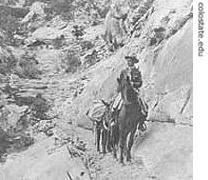
John Otto, first superintendent of Colorado National Monument
the park. He did not build a house. He moved from place to place and lived in a temporary cloth home.

In a letter written in nineteen-oh-seven, Mister Otto told a friend the area made him feel like it was the heart of the world. He told his friend he was going to stay and build paths and work to inform people about this beautiful work of nature. Some people thought he was insane.

But John Otto began his campaign to protect the area by writing letters. He acted as a guide for people who read his letters and came to see the great natural beauty for themselves. He asked everyone who visited for their support in his campaign to have the federal government protect the area.

VOICE TWO:

In nineteen eleven, President William Taft signed the documents making the area a national monument. It would forever be part of the National Park System and protected by the government.

President Taft also appointed Mister Otto as the new park’s first top official. John Otto was only paid one dollar a year for this work. He was not expected to really work at the park, just deal with administrative duties, which were few.

However, John Otto did work in the park. By nineteen twenty-one he had finished building one of the first major paths. This made it much easier for people to visit the area. He built it using simple tools and without much help. It is called the Trail of the Serpent. He was also very careful to build the trail without damaging any of the area’s natural beauty. It was one of the first roads into the park that could be used by an automobile.

VOICE ONE:

High up in the Colorado National Monument is a steel sign that honors John Otto. It has been placed into the wall of a rock formation that John Otto loved. The marker says: “In recognition of John Otto, trail builder, promoter, and first custodian of Colorado National Monument, established May twenty-fourth, nineteen eleven.” John Otto would have liked that.

(MUSIC)

VOICE TWO:

The Colorado National Monument is almost eight thousand three hundred hectares. It is near the city of Grand Junction, Colorado, not far from the state border with Utah. The area is known for its mountains and the beauty of the desert. It is also here that the last of the Rocky Mountains begin to drop away to flat land.

Although the Colorado National Monument is smaller than most national parks, about five hundred thousand visitors come each year. Most visitors drive on the Interstate Highway System.

Interstate Highway Seventy is only a few kilometers from the park. When a visitor leaves the road, the path becomes much smaller and begins to rise into the mountains. Signs urge safety. Other signs urge the driver of the vehicle to slow down.

VOICE ONE:

The small road begins to turn left, then sharply to the right, then left again. At the same time it moves up and up many meters at a time with each turn.

At first, mountains surround the road on both sides of the car. Then, without warming, the little road moves into the clear and visitors can see hundreds of meters down into the valley. For a little more than six kilometers the road twists and turns high into the park.

At the top of the little road visitors reach the National Park Visitors Center. The modern building provides information about the park. It has a small store where visitors can buy gifts. The Visitors Center also includes a small museum with fossils, photographs and the story of John Otto.

VOICE TWO:

When visitors have collected the information or gifts they want, most continue through the building to an observation area in back of the building. Slowly they walk to the very edge of the mountain.

In this great open space, the finger-like rocks seem to reach for the sky. Far below is the great natural beauty that took more than one thousand million years for nature to create.

And, it is here they can begin to understand why John Otto loved this place so much and why he worked so hard to protect it.

(MUSIC)

VOICE ONE:

This program was written by Paul Thompson. It was produced by Mario Ritter. This is Faith Lapidus.

VOICE TWO:

And this is Steve Ember. Join us again next week for another EXPLORATIONS program in VOA Special English.

7.17.2007

US Senate Democrats Plan Around-the-Clock Debate on Iraq


17 July 2007

Download

U.S. Senate Democratic leaders are planning an around-the-clock debate on Iraq beginning Tuesday to try to pressure Republicans to vote for legislation calling for a withdrawal of U.S. combat troops from Iraq by next April. VOA's Deborah Tate reports from Capitol Hill.

The Democratic-sponsored troop withdrawal measure calls for the pullout to begin within 120 days after passage and completed by April of next year. Some troops would remain in Iraq to train Iraqi forces and fight terrorism.

The House of Representatives passed similar legislation last week, but prospects for passage in the Senate appear dim.

Senate Republicans echo the White House position that setting a timetable for a withdrawal from Iraq would amount to surrendering to terrorists.

"To execute a precipitous withdrawal from Iraq now, regardless of the conditions on the battlefield, and regardless of the advice of our commanders in the field, is unthinkable," said Senator Jeff Sessions, an Alabama Republican. "It would be a stain on this Senate for years to come."

Senate Majority Leader Harry Reid (r), followed by Sen. Charles Schumer, center, and Sen. Richard Durbin, arrives for a news conference on Capitol Hill in Washington, 16 July 2007
Republican opponents are vowing to block the measure from coming to a vote, prompting this response from the Senate's top Democrat, Majority Leader Harry Reid of Nevada.

"Republicans are more interested in protecting the president than our troops," he said.

Reid says more than 50 senators back the measure - enough to pass it on a simple majority vote in the 100-member chamber.

But at least 60 votes are needed under Senate rules to overcome any effort to halt the legislation - a margin that continues to elude supporters.

Opponents say Senator Reid's plan to hold the Senate in session for an all-night session will not make them back down.

Besides the troop pullout legislation, the Senate is also debating a Republican-backed proposal calling on President Bush to send Congress plans to begin downsizing the U.S. combat troop presence in Iraq by the end of the year. Those plans are to be sent to Congress by mid-October.

The proposal, co-sponsored by influential Republican Senator John Warner of Virginia, also calls on the president to seek a new congressional war authorization for military operations in Iraq.

"I feel that in view of all that has transpired in nearly five years - this will be five years since we passed it this October, it is the duty of Congress to review it," he said.

But many Democrats believe that proposal does not go far enough because it does not require that troops be redeployed, but only that the president submit plans for their withdrawal.

"It is not enough to pass something that sounds good but does not move us toward ending the war," said Senator Russ Feingold, a Wisconsin Democrat.

The Iraq-related measures are being proposed as amendments to a defense policy bill.

US Court Approves $660 Million Settlement in Clergy Abuse Cases


17 July 2007

Download

A judge has approved a $660 million settlement between more than 500 alleged victims of clergy abuse and the Catholic Archdiocese of Los Angeles. VOA's Mike O'Sullivan reports, the landmark agreement follows four-and-a-half years of negotiations.

Judge admonishes people in the audience to stop heckling at Los Angeles court where $660 million settlement approved between Roman Catholic Archdiocese of Los Angeles and more than 500 alleged victims of clergy abuse, 16 July 2007
It is the largest payout by any U.S. Catholic diocese since the clergy abuse scandal erupted in Boston in 2002. As part of the settlement, Los Angeles church officials will release the personnel records of the accused priests, after a judge reviews them.

Some of the cases date back to the 1940s, and the agreement amounts to $1.3 million for each plaintiff. Lawyers will receive up to 40 percent of the settlement for their legal fees.

"Far more important than the money, though, is a critical term of this settlement, [which] provides for transparency, for sunshine, and for the release of the confidential files and personnel records of the priests that were involved in molesting so many children over the last five or so decades," said Ray Boucher, lead attorney for the plaintiffs.

Cardinal Roger Mahony, who heads the archdiocese, sat quietly through Monday's hearing. Sunday, he apologized to the victims.

"It should not have happened, and should not ever happen again," he said.

Some angry plaintiffs say the church agreed to a settlement only as the trial date was approaching. The first case was scheduled to start this week.

The cost of the settlement will be divided among the archdiocese, insurance companies and several Catholic religious orders. Cardinal Mahony says the archdiocese will sell some property, including its headquarters, but will not close parish churches or parochial schools.

Abuse cases around the United States have cost the Catholic Church more than $2 billion.

Bush Increases Support for Palestinian President Abbas


16 July 2007

Download

President Bush is making a new push for Middle East peace. VOA White House correspondent Paula Wolfson reports he is calling for an international conference this year to move the peace process forward, and is pledging to increase aid to the Palestinian government of Mahmoud Abbas.

President Bush addresses the Mideast peace situation in Cross Hall at the White House in Washington, 16 Jul 2007
President Bush is seeking to bolster Mahmoud Abbas and his government with diplomacy and aid.

"By supporting the reforms of President Abbas and Prime Minister Fayyad, we can help them show the world what a Palestinian state would look like and act like," he said. "We can help them prove to the world, the region and Israel that a Palestinian state would be a partner, not a danger."

Mr. Bush says the United States will sponsor an international conference later this year involving Israel, the Abbas-led government and other countries in the region that support a two-state solution to the Israeli-Palestinian dispute and reject violence. He says the goal is to bring the dream of a Palestinian state much closer to reality.

"Secretary [of State] Rice will chair the meeting," said Mr. Bush. "She and her counterparts will review the progress that has been made toward building Palestinian institutions. They will look for innovative and effective ways to support further reform. And they will provide diplomatic support for the parties in their bilateral discussions and negotiations."

President Bush is also promising more U.S. aid to "strengthen the forces of moderation and peace among the Palestinian people." He says about $190 million has been set aside this year, and that 80 million would go directly to the government of Mahmoud Abbas to help reform the Palestinian security services.

"With all this assistance, we are showing the Palestinian people that a commitment to peace leads to the generous support for the United States," he said.

In a roughly 20-minute speech from the White House, the president noted that aid to the Palestinians - except for certain humanitarian assistance - was cut off after the Islamic militant group Hamas won parliamentary elections in January 2006. It was restored recently after President Abbas, whose Fatah forces were routed by Hamas in the Gaza Strip, replaced the Hamas prime minister.

Mr. Bush said it is clear the Palestinian people are at a crossroads in their history.

"This is a moment of clarity for all Palestinians and now comes a moment of choice," said the president.

He said the world must help show them the way.

"We must show that in the face of extremism and violence, we stand on the side of tolerance and decency," said Mr. Bush. "In the face of chaos and murder, we stand on the side of law and justice. And in the face of terror and cynicism and anger, we stand on the side of peace in the Holy Land."

The president said there is a great deal for all sides to do. He urged the Israelis to stop settlement expansion and remove unauthorized outposts in Palestinian territory. And he called on the Palestinian government to do all it can to confront terrorism and block attacks on Israel.

Britain Expelling Russian Diplomats as Anger Over Spy Murder Case Intensifies


16 July 2007

Download

Britain is expelling four Russian diplomats and exploring other retaliatory measures after the refusal by Moscow to send former intelligence officer Andrei Lugovoi to London for trial in the murder of his former colleague, Alexander Litvinenko. Moscow says the British move will lead to serious consequences when Russia responds. For VOA, Tom Rivers reports from London.

British-Russian relations have taken a frosty turn with the decision by London to expel a number of Russian diplomats after Moscow's refusal to extradite the main suspect in the murder of Alexander Litvinenko.

Former Russian intelligence officer Litvinenko died last November after being poisoned with the radioactive substance, polonium-210 in the British capital.

Andrei Lugovoi, May 2007
Among the last people he met on the day he became ill was a former colleague of his, Andrei Lugovoi.

Lugovoi has repeatedly denied any involvement in Litvinenko's death, and Moscow has formally told London that a request for his extradition could not be fulfilled as it would be in breach of the Russian constitution.

In the House of Commons, Foreign Secretary David Miliband underlined that the British government continues to take matter very seriously.

"Our aims are clear," said Mr. Miliband. "First, to advance our judicial process, second, to bring home to the Russian government the consequences of their failure to cooperate and third, to emphasize our commitment to promoting the safety of British citizens and visitors."

British Foreign Secretary David Miliband, Jun 2007
Given the impasse, Mr. Miliband outlined a number of measures London will impose on Moscow.

"First, we will expel four diplomats from the Russian embassy in London," he said. "Second, we shall review the extent of our cooperation with Russia on a range of issues and as an initial step, we have visa facilitation negotiations with Russia and made other changes to visa practice."

"Third, international agreements mean Mr. Lugovoi could be extradited to the UK if he traveled abroad. Fourth, we are grateful for the strong support we have received from EU [European Union] partners and close allies, including through the EU presidency statement on the first of June. We will discuss with partners the need for future EU-Russian engagement to take up concerns on this case into account," he continued.

Russia promises to give what it calls an "adequate response" to the British expulsion order. Part of that response may come in the form of reprisal tit-for-tat expulsions and a return to cooler relations in general.

UN Secretary-General Presses for Quick Action on Darfur


16 July 2007

Download

During a briefing about his just completed two-week trip to Afghanistan and Europe, U.N. Secretary General Ban Ki-moon says Darfur dominated discussions. From VOA's New York Bureau, correspondent Barbara Schoetzau reports Mr. Ban says it is time to push the pace of progress.

Ban Ki-moon (file photo)
The secretary-general says he hopes the Security Council will pass a resolution authorizing a hybrid peacekeeping operation within the week.

Last month, Sudan unconditionally accepted an U.N.-African Union peacekeeping force, which will include as many as 26,000 military personnel and civilian police. The draft resolution also calls on member states to finalize their contributions to the force within 90 days.

Mr. Ban says this is fast by U.N. standards, but not fast enough.

"The political situation of the ground is too fragile, the humanitarian crisis too dire to waste more precious time," he said.

Sudan objects to the draft resolution's stress on humanitarian issues and the threat of "further measures," possibly sanctions.

Mr. Ban says he intends to accelerate the U.N. timetable to the maximum on both the military and political fronts.

"Working with our many partners, chief among them the African Union, we must start preparing the ground for our peacekeepers immediately," he said. "The Chinese government will soon send a contingent of military engineers to Darfur, where they will begin the essential communications and logistical work that must precede the mission. In fact, a preliminary reconnaissance group leaves for Sudan July 17. I am informed that several hundred international troops, or more, will be ready to deploy by October. I will push for September."

Mr. Ban described initial talks in Libya between diplomats and divided rebel groups as "successful". He said the goal is to step up the pace of negotiations and bring all factions - government, rebels and tribal leaders - to the table by early September to find a political solution.

The secretary-general says he intends to visit Sudan, including Darfur, at the earliest possible moment.

VOASE0716_Agriculture Report

16 July 2007
Many US Farmers Struggle With Hot, Dry Weather

Download
Download

This is the VOA Special English Agriculture Report.

An Alabama farmer holds corn from his farm damaged by drought
Heat and drought are threatening some of America's most productive farmland.

The Department of Agriculture says an early summer heat wave across the West has increased demand for water to save dry crops. But in many areas, water supplies are limited. Water is also needed to fight wildfires in western states like California, Nevada and Washington.

Temperatures have reached about thirty-eight degrees Celsius recently in parts of Colorado, Montana and Wyoming. The Agriculture Department says temperatures averaged several degrees above normal.

Some people in the West say they cannot remember a time with less rain in half a century. But drought conditions have been most severe in the South.

The northern part of Alabama is described as the driest in about one hundred years. With grasslands damaged, many farmers in Mississippi, Georgia and Tennessee have no hay to feed their cows. So they have sold up to half of their cattle early.

In southern Alabama and northern Tennessee, farmers also suffered through a dry period last year. Some were hoping for a big corn crop this year to sell for ethanol fuel. But the government says most of their crop is in poor or very poor condition.

Experts say soybeans and cotton look better -- but not very much. Federal officials have declared all counties in Alabama a drought disaster area. That means farmers can get low-cost emergency loans. But they are asking Congress for an additional seventeen million dollars in aid.

Ten million would go to drilling for water and regrowing pasture lands. The other money would go to cattle producers to help them recover their losses from selling early.

But drought is not the only weather problem right now for American agriculture. Recently, too much rain fell for some crops in the southeastern Plains. Heavy rain and flooding in the lowlands damaged wheat planted in the winter.

To the east, rains of twenty-five centimeters or more in areas struck the western Gulf of Mexico. The rains washed out fields and flooded lowlands.

But farmers welcomed heavy rainfall in early July from the Mississippi River Delta to the southern Atlantic coastal area. Farmers have also received some welcome rains along the Corn Belt. This area includes the Ohio Valley and parts of the Upper Midwest.

Summer crops in the Midwest have been mainly free of the drought suffered in other areas this summer.

And that's the VOA Special English Agriculture Report, written by Jerilyn Watson. I'm Steve Ember.

VOASE0716_Science In the News

16 July 2007
'Dreamliner' Is Boeing's Most Popular New Plane, Even Before First Flight

Download
Download

VOICE ONE:

This is SCIENCE IN THE NEWS in VOA Special English. I'm Barbara Klein.

VOICE TWO:

A Boeing 787 being built at Boeing's factory in Everett, Washington
And I'm Steve Ember. On our program this week, we will tell about a new airplane from the American company Boeing. We will also tell about warning signs for ovarian cancer. And, we tell about a television performer who invented science shows for children.

(MUSIC)

VOICE ONE:

The Boeing Company presented its newest jet airplane earlier this month to a crowd of employees and invited visitors. About fifteen thousand people attended the presentation on July eighth at Boeing's factory in Everett, Washington.

The company is calling its new plane the Seven Eighty-Seven Dreamliner. The plane is Boeing's first new jet since nineteen ninety-five.

The Seven Eighty-Seven is designed to travel great distances. It can carry between two hundred ten and three hundred thirty people.

VOICE TWO:

Boeing says the plane will be made mostly of carbon-fiber composite material instead of aluminum. A plane made of carbon-fiber weighs less than a metal plane. As a result, it requires less fuel to do the same job.

Boeing says the Seven Eighty-Seven will use twenty percent less fuel per passenger than similarly sized planes. It also says the plane will make less noise taking off and landing. And it will produce less carbon dioxide than traditional jets. Studies have linked rising temperatures on Earth to human production of gases like carbon dioxide.

VOICE ONE:

The new jet plane has yet to leave the ground. Boeing says the first Dreamliner will be completed in the factory in Everett. The Seven Eighty-Seven still needs flight test and other equipment to be added. The first flight is expected in late August or September. Boeing officials say they expect the plane to start carrying passengers in May, two thousand eight.

The company says the Dreamliner is Boeing's most successful new plane. By July eighth, Boeing had already received six hundred seventy-seven orders from forty-seven buyers. The orders are worth more than one hundred ten billion dollars.

(MUSIC)

VOICE TWO:

Ovarian cancer is known as a silent killer because it is usually discovered too late to save a woman's life. But three cancer groups in the United States have now agreed on a list of possible early signs of the disease.

The statement is the first of its kind to recognize what ovarian cancer survivors have long believed: that there are common signs. Researchers have found that these symptoms are more likely to happen in women with ovarian cancer than women in general.

VOICE ONE:

One symptom is expansion of the lower chest or abdomen. Pain in the abdomen or the pelvis can be another symptom. Researchers also say women with an early form of ovarian cancer may release waste fluids more often or with greater urgency. And they say another common symptom is difficulty eating or feeling full quickly. Women who have these symptoms almost daily for more than a few weeks are advised to see a doctor.

The cancer can affect one or both ovaries, the organs that produce eggs. Doctors say the main ways to find the disease early are recognizing the symptoms and getting a combination pelvic and rectal examination.

VOICE TWO:

Ovarian cancer kills more than one hundred thousand women around the world each year. In the United States, cancer experts estimate that at least fifteen thousand women will die of it this year. And more than twenty-two thousand new cases will be found. Ovarian cancer is the fifth leading cause of cancer deaths in women.

The Gynecologic Cancer Foundation led the effort for the statement on common symptoms. The American Cancer Society and the Society of Gynecologic Oncologists also were involved. Other cancer groups have expressed support for the statement.

VOICE ONE:

Doctor Barbara Goff at the University of Washington in Seattle was a lead investigator of several studies that gave support to the new list. She says most of the time a woman with these symptoms will not have ovarian cancer. But the disease can spread quickly to nearby organs.

A few months can mean life or death. Doctor Goff notes that the disease is ninety percent curable when found in its earliest form.

(MUSIC)

VOICE TWO:

An operation while doctors in other cities watch through a live video feed
Telemedicine uses technology to provide medical information and services. It involves satellite technology, wireless telephones, and computers. Telemedicine could be as simple as two doctors using a telephone to discuss a case. Another example might be health care providers studying x-rays of patients who might be thousands of kilometers away.

Many telemedicine programs operate through hospitals, home care agencies or university medical centers.

VOICE ONE:

Recently, Temple University in the American city of Philadelphia began a four-year study. Temple is using an Internet-based system is to study the prevention and treatment of obesity in high-risk populations. Researchers are working with religious centers to test whether telemedicine can help overweight African Americans in the Philadelphia area.

Temple University’s Center for Obesity Research and Education gave one computer to each church. Those taking part in the study attend weekly meetings at a church with a trained organizer. Each group has eight to twelve members. They are learning how to use the Internet, including electronic mail and what are called chat rooms. They share ideas on how to prepare healthy foods and they plan their next meetings. Through technology, the members continue to support their families, friends and each other in their health care.

VOICE TWO:

Telemedicine has been useful in places where there are not enough doctors. Health care experts in Africa say the continent faces the problem of too much disease with too few doctors.

Maurice Mars works on telehealth issues at the University of Kwazalu-Natal in South Africa. Doctor Mars says southern Africa has fewer than ten doctors for every one hundred thousand people.

Telemedicine is still new to Africa. It has only a few successful programs that can treat people in distant areas. The technology remains costly. Doctor Mars says that kind of spending in not possible for developing countries. He says many countries cannot pay for even Internet services.

(MUSIC)

VOICE ONE:

Last month, the United States House of Representatives passed a resolution honoring the television performer Don Herbert. To many Americans, he was better known as Mister Wizard.

Don Herbert died of cancer on June twelfth. He was eighty-nine years old. But his television shows and their influence live on.

Don Herbert started appearing on the children’s show “Watch Mr. Wizard” in March, nineteen fifty-one. He appeared as a scientist who liked to perform scientific experiments in his home.

VOICE TWO:

The show always involved a boy or girl as his assistant. Mister Wizard always had a small experiment prepared or a scientific question to investigate. For example, in one show, he taught a girl about sound and what gives musical instruments their different noise levels. In another show, he showed a boy how to make a small volcano. His weekly program was broadcast for fifteen years.

Don Herbert later taught science to a new generation of Americans on a show called “Mr. Wizard’s World.” This show started in nineteen eighty. It was broadcast three times a week for seven years. You could watch Mr. Wizard and a child perform experiments like turning a clear liquid black or making foods explode using a simple chemical reaction.

VOICE ONE:

Don Herbert’s television shows taught young people that science could be educational, but also fun and exciting. His experiments were simple and direct. He used everyday objects from around the home. They were also interesting enough for parents to watch.

Congressman Vernon Ehlers helped to create the resolution to honor the man known as Mister Wizard. He said Don Herbert invented the business of young people watching fun science shows on television. The Congressman said Mister Herbert was a good guy who did a good job.

(MUSIC)

VOICE TWO:

This SCIENCE IN THE NEWS program was written by Lawan Davis, Dana Demange, George Grow and Caty Weaver. Brianna Blake was our producer. I'm Steve Ember.

VOICE ONE:

And I'm Barbara Klein. You can read and listen to this program on our Web site, voaspecialenglish.com. Join us again next week for more news about science in Special English on the Voice of America.